P-ISSN: 2664-8776
E-ISSN: 2664-8784

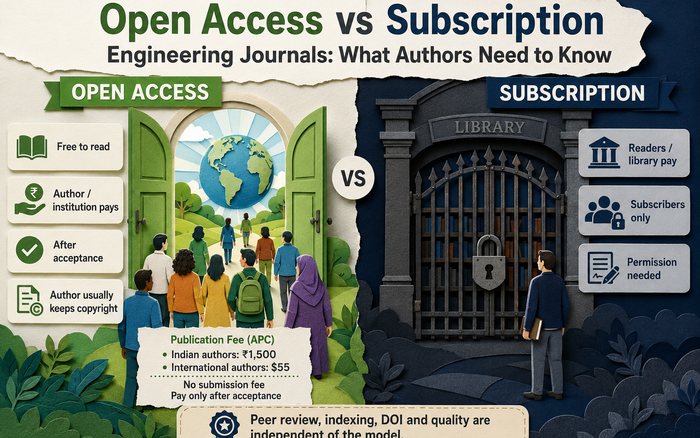
The difference between open access and subscription publishing is who pays and when. In a subscription journal the reader — usually their library — pays to read, and the author normally pays nothing. In an open access engineering journal the article is free to read from the day it appears, and the cost is met by the author, their institution or a funder, usually after acceptance. Peer review, indexing, DOIs and quality are independent of which model a journal uses.
This choice affects who will actually read your engineering journal paper, what you are allowed to do with it afterwards, and how much you pay. It is worth ten minutes before you submit rather than a surprise after acceptance.
| Open access | Subscription | |
|---|---|---|
| Who pays | Author, institution or funder | Reader or their library |
| When | After acceptance | Ongoing, per subscription |
| Who can read it | Anyone, immediately | Subscribers only, often with an embargo for others |
| Copyright | Usually retained by the author | Often transferred to the publisher |
| Reuse | Governed by a Creative Commons licence | Permission needed from the publisher |
| Reach | No barrier for industry, consultants, small institutions | Limited to those who can afford access |
That last row matters more in engineering than in many fields. A great deal of engineering research is used by people outside universities — practising engineers, consultancies, standards committees, small manufacturers, regulators. Very few of them hold journal subscriptions. A paywalled paper on a failure mechanism reaches the researchers studying it and almost nobody who has to design around it.
Open access is a statement about the reader, not about the author’s wallet. It means the article is:
All of these apply here — the terms are on the Open Access Policy page. What open access does not mean is that publishing is free. Formatting, the publication process and hosting still cost something; the money simply comes from a different direction.
At this engineering journal the arrangement is stated openly:
The journal receives no governmental or non-governmental financial support, and the fee covers formatting, the publication process and website maintenance.
The sequence matters more than the amount. A charge that falls after peer review cannot influence the review decision. A journal that asks for money before review, or will not tell you the amount until after acceptance, is telling you something about how its review works.
Two journals can both be fully open access and still give readers very different rights. The licence decides that, and you will meet two most often:
| CC BY 4.0 | CC BY-NC 4.0 | |
|---|---|---|
| Share the article | Yes | Yes |
| Adapt and build on it | Yes | Yes |
| Credit required | Yes | Yes |
| Commercial use | Allowed | Not without permission |
This journal applies Creative Commons Attribution-NonCommercial (CC BY-NC). Anyone may download, reuse, reprint, modify, distribute and copy the work for non-commercial purposes provided the original authors and source are cited. Commercial reuse needs prior permission and charges apply.
Check your funder’s conditions before choosing a journal. Some funders and institutions require a specific licence — several mandate CC BY — as a grant condition. That requirement narrows your list of eligible journals, and it is far easier to discover before submission than after acceptance.
A third model sits between the two and confuses people: the hybrid journal. It is a subscription journal that also lets individual authors pay to make their own article open access. Libraries still pay the subscription; the author pays on top.
Two things to know before choosing one. The charges are typically several times higher than at a fully open access engineering journal, because you are buying an exception rather than the normal route. And critics call the model “double dipping” — the publisher collects from the library and the author for the same content. Some funders will not pay hybrid charges at all, so check before you commit.
| Stage | Open access | Subscription |
|---|---|---|
| Submission | No fee | Usually no fee |
| Peer review | Identical process | Identical process |
| On acceptance | Processing charge falls due | Usually nothing; often a copyright transfer form |
| On publication | Free to everyone immediately | Behind the publisher’s paywall |
| Sharing your own PDF | Permitted under the licence | Often restricted; check the agreement |
| Reuse of your own figures | Permitted | May need permission from the publisher you signed with |
The last row surprises authors most. Transfer copyright and you can need permission to reuse your own figure in your own later paper. Under CC BY-NC you keep that right.
Some will. So will some subscription journals. The business model does not determine the standard — the review process does, and that is checkable in a paragraph on the journal’s own site. Judge that instead.
The opposite argument is more often made, but neither claim should decide anything for you. Citations depend far more on the work, the field and the venue’s reach than on the payment model. Do not choose a journal on a claim you cannot verify for your own subject.
Only if the fee falls before review. Where it falls after acceptance, as here, the decision has already been made by people who were not told what you would pay. That is exactly why the sequence is worth checking on any engineering journal.
Under a subscription engineering journal authors are frequently asked to transfer copyright to the publisher. Not here:
The practical effect: you can reuse your own figures in later work, include the paper in your thesis, and put it on your own page without asking anyone.
The most damaging confusion here is treating “open access” as a quality signal in either direction. It is not one. What tells you about quality is separate, and all of it is checkable before you submit:
A journal that cannot answer these is a risk whatever its access model. One that can is worth considering whatever its access model.
No, and this is the commonest confusion. Open access means free for the reader. The cost usually moves to the author as a processing charge. At this journal there is no submission fee, but a charge of 1,500 INR for Indian authors or 55 USD for international authors applies after acceptance.
Not here. Authors retain ownership of the copyright of their own work and no transfer is required. What you grant is a licence for others to reuse the work under stated conditions, which is not the same as giving the copyright away.
CC BY allows sharing and adaptation for any purpose including commercial use, with credit. CC BY-NC allows the same but only for non-commercial purposes. This engineering journal applies CC BY-NC, so commercial reuse needs prior permission.
Check the journal's repository policy before you assume either way. Most open access journals permit it; subscription publishers often allow it only after an embargo period.
The access model and the quality control are separate things. A subscription journal with weak review is worse than an open access journal with strong review, and the reverse is equally true. Judge the review process, not the business model.
Not at this journal. Every article is free to read and download from the moment it is published, with no subscription and no registration.
The money and the rights, in more detail:
Created by Gopal Singh • 22 Jul 2026
P-ISSN: 2664-8776
E-ISSN: 2664-8784

International Journal of Research in Engineering