P-ISSN: 2664-8776
E-ISSN: 2664-8784
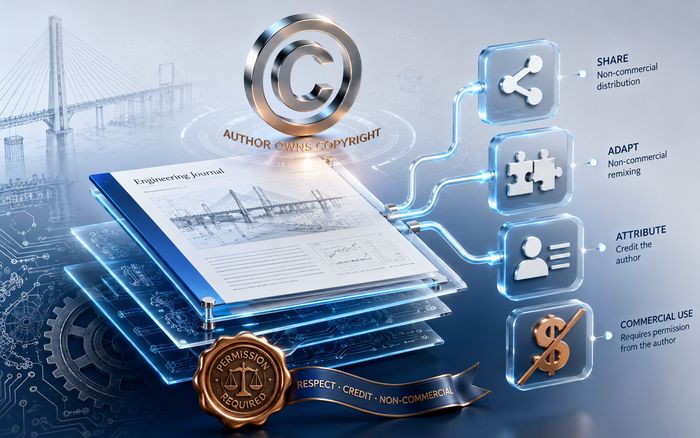
At this engineering journal you keep the copyright to your own work. Articles are published under a Creative Commons Attribution-NonCommercial (CC BY-NC) 4.0 licence: anyone may download, reuse, modify and distribute the paper for non-commercial purposes with credit to you and to the journal. Commercial reuse needs prior permission and charges apply.
Most engineering journal authors sign whatever the form says and find out what it meant years later, usually when they want to reuse their own figure. Ten minutes now saves that.
| Copyright | Licence | |
|---|---|---|
| What it is | Ownership of the work | Permission granted to others |
| Who holds it here | You, the author | Granted by you, stated by the journal |
| Can it be given away? | Yes, by transfer — not required here | It is a grant, not a transfer |
| What it controls | Everything you may do with the work | What readers may do with it |
Keeping copyright while granting a licence is the arrangement at this engineering journal. You have not given anything away; you have told the world what it may do.
That last condition is the one that distinguishes it from plain CC BY, which allows commercial use too. Commercial reuse of an article here is not covered by the licence: it requires prior permission from the journal, and charges apply. The exact terms are on the content licensing policy page.
Under a copyright transfer, several of those need the publisher’s permission. Authors are routinely surprised to need clearance to reuse a figure they drew.
In any engineering journal the obligation runs both ways, and this is where authors most often create a problem for themselves.
| Source licence | Can you reuse it? | What you must do |
|---|---|---|
| CC BY | Yes, including commercially | Full attribution |
| CC BY-NC | Non-commercially | Full attribution |
| All rights reserved | Only with written permission | Obtain it before submitting, and say so |
| Your own earlier paper | Depends who holds the copyright | If transferred, you may need permission |
Redrawing a figure does not remove the obligation if the content is substantially the same — cite the source. And a figure taken from a website is not automatically free to use; the absence of a licence statement means all rights reserved, not permission granted.
Attribution is not complicated, but it has to be complete. For a figure taken or adapted from another paper, the caption should carry all four elements:
Fig 4: Stress-strain response of the treated specimens. Reproduced from [12] under a CC BY-NC 4.0 licence.
Or, where you have changed it:
Fig 4: Stress-strain response, adapted from [12] with permission.
Four things: what it is, where it came from, what you did to it, and under what permission. Missing the last one is the commonest omission, and it is the one that creates a problem after publication rather than before.
| Question | Answer here | Why it matters to you |
|---|---|---|
| Who owns the paper? | You | You can reuse it freely |
| Who may read it? | Anyone, immediately | No paywall between your work and its readers |
| Who may reuse it? | Anyone, non-commercially, with credit | Teaching, theses, further research |
| Who may sell it? | Nobody without permission | Commercial reuse needs clearance from the journal |
| Where can you put it? | Institutional or subject repository, personal page | Sherpa/Romeo Green policy |
| What identifies it? | A Crossref DOI, prefix 10.33545 | It stays citable and findable |
That combination — author-held copyright, immediate open access, non-commercial reuse and a registered DOI — is what an open access engineering journal is supposed to offer. It is worth checking against any journal you are considering, because the four do not always come together.
If you hold the copyright, this is straightforward: include it and cite the published version. If you transferred copyright to a different publisher for an earlier paper, check their thesis policy before you paste it in. Most permit it; some require a specific form of words.
Copyright here is held by the authors, which means jointly where there is more than one. Commercial use of the article itself still needs the journal’s permission under the CC BY-NC terms, and that is worth clarifying between co-authors early if any of you expects to use the material in consulting or training work.
Copyright is about ownership; authorship is about credit and accountability. Everyone listed as an author should have contributed to the work and be able to defend it, and everyone who contributed materially should be listed.
The problems that arise here — a supervisor added by convention who did not contribute, a technician omitted who did — are far easier to settle before submission than after. Agree the author list and the order while the paper is being written, not when it is being submitted.
Five questions, ten minutes, and none of them get easier to answer later.
None of this is legal advice, and a genuinely contested case belongs with your institution’s research office. But the ordinary situations authors meet — reusing a figure, depositing a paper, including a chapter in a thesis — are settled by knowing two things: who holds the copyright, and what the licence says. At this journal the answers are you, and CC BY-NC 4.0.
The habit worth building is simply reading the licence line before you sign anything. It is one sentence on most journal sites, and it decides what you may do with your own work for the rest of your career.
One sentence is worth memorising for any journal you consider: who holds the copyright, and which licence applies? If a site cannot answer both in one place, that is itself informative.
Yes. Authors publishing in this engineering journal keep the copyright of their own work. The journal does not require a copyright transfer, which is different from many subscription publishers.
Creative Commons Attribution-NonCommercial (CC BY-NC) 4.0. Readers may download, reuse, reprint, modify, distribute and copy the work for non-commercial purposes as long as the original authors and source are cited.
Any reuse for commercial advantage — reproducing the article in a paid training course, in a product brochure, or in material sold for profit. That is not covered by the licence and needs prior permission from the journal, with charges applying.
Yes. Authors may deposit the published version in an institutional repository, a subject repository, or a personal or departmental page, in line with the Sherpa/Romeo Green policy.
Yes, because you hold the copyright. This is one of the practical differences between retaining copyright and transferring it — under a transfer you can need the publisher's permission to reuse your own figure.
Yes, unless its licence permits reuse. Check the licence of the source article, and give full attribution either way. A CC BY-NC figure can be reused non-commercially with credit; an all-rights-reserved figure needs written permission.
The publishing model behind the licence:
Created by Hannah Weber • 08 Aug 2026
P-ISSN: 2664-8776
E-ISSN: 2664-8784

International Journal of Research in Engineering