P-ISSN: 2664-8776
E-ISSN: 2664-8784

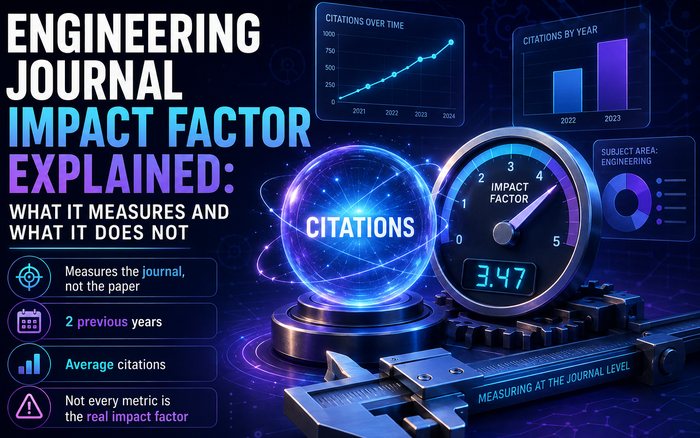
The Clarivate Journal Impact Factor is the average number of citations received in one year by the articles a journal published in the two previous years. It describes the journal, not any individual paper, and only journals indexed in Clarivate’s Web of Science receive one. Numbers from other organisations with similar names are not the same metric.
Authors are told to publish in high-impact engineering journals without ever being told what the number counts. It is worth ten minutes, because the misunderstandings around it cost people real decisions.
The arithmetic is simple. For a 2026 impact factor:
Citations in 2026 to articles published in 2024 and 2025
÷
Number of citable articles published in 2024 and 2025
Two consequences follow immediately, and both are worth holding on to:
| Impact factor | |
|---|---|
| Describes | The journal, averaged over two years |
| Does not describe | Your paper |
| Does not measure | Quality of peer review |
| Does not measure | Whether your paper will be read by the people who need it |
| Comparable across fields? | No — citation habits differ enormously |
| Available for every journal? | No — only Clarivate-indexed titles |
The row that matters most is the second. Your paper’s value is its own citations and its own readers. A well-cited paper in a modest journal is worth more to you than an uncited one in a famous journal — and hiring and funding panels increasingly say so.
This is where authors assessing an engineering journal get misled, and it is deliberate. Several organisations publish numbers with names close enough to be mistaken for the Clarivate figure, sometimes for a fee, with methodologies that are not disclosed.
One test settles it: can you identify who calculated the number, and find the method? The Clarivate figure appears in Journal Citation Reports and can be checked there. A number that appears only on the journal’s own homepage, credited to an organisation you cannot find independently, is marketing.
If a journal quotes an “impact factor” and you cannot find who issued it, treat the number as absent rather than as low.
| Metric | What it counts | Who publishes it |
|---|---|---|
| Journal Impact Factor | 2-year citation average | Clarivate (Journal Citation Reports) |
| CiteScore | 4-year citation average | Elsevier (Scopus) |
| SJR | Citations weighted by source prestige | Scimago |
| h-index | Applied to authors or journals; balances output and citations | Various |
They measure different windows and different sources, so they do not agree and are not meant to. Quoting one without naming which is how confusion starts.
Authors sometimes find one engineering journal quoted with three different numbers on three different sites and assume someone is lying. Usually nobody is. The numbers count different things:
None of this makes the numbers useless. It makes them incomparable across systems, which is a different problem — and it is why any figure quoted without naming the system and the year should be treated as decoration.
Comparing impact factors across engineering sub-fields is the most common misuse, and it is easy to see why it fails once you look at the mechanics rather than the numbers.
A field with many active researchers, short papers and fast-moving problems generates a lot of citations within two years. A field where the useful output is a small number of long papers, read carefully by a smaller community and cited over a decade, generates very few — and the two-year window closes before most of them arrive.
So a 1.8 in one sub-field can represent a stronger position among its peers than a 4.5 does in another. The only meaningful comparison is between journals a reader would genuinely consider as alternatives for the same paper.
One practical point authors rarely consider: the figure you see today describes citations to papers published two and three years ago. It says nothing about the journal as it is run now.
A journal that changed editors, tightened its review or broadened its scope last year will not show any of that for another two to three years. If you are assessing an engineering journal as it exists today, the review policy, the indexing and the archive tell you more about current practice than a metric describing its past.
For deciding where to send a paper, these affect the outcome far more than any metric:
Our guide on choosing an engineering journal works through all of these as a one-hour check.
The Clarivate Journal Impact Factor is the average number of citations in one year to articles a journal published in the two preceding years. It is calculated by Clarivate and published in Journal Citation Reports; only journals indexed there have one.
No. Only journals indexed in Clarivate's Web of Science Core Collection receive one. A journal without it is not automatically weak — it simply is not in that index.
There is no universal answer, because the number depends heavily on the sub-field. Citation habits differ enormously between, say, biomedical engineering and structural engineering, so comparing across fields is meaningless.
Because several organisations sell official-sounding metrics with no relationship to the Clarivate figure. If you cannot identify who calculated a number and how, treat it as marketing rather than a metric.
It should be one input among several, and rarely the first. Scope, verifiable indexing, a described review process and registered DOIs affect whether your paper is published and found; the impact factor does not.
No, and this is the most damaging confusion. The impact factor describes the journal, averaged across all its articles. Your paper's own citations are what count for you, and a well-cited paper in a low-scoring journal beats an uncited one in a high-scoring journal.
The metrics this one is most often confused with:
Created by Sandeep Rathore • 08 Aug 2026
P-ISSN: 2664-8776
E-ISSN: 2664-8784

International Journal of Research in Engineering