P-ISSN: 2664-8776
E-ISSN: 2664-8784
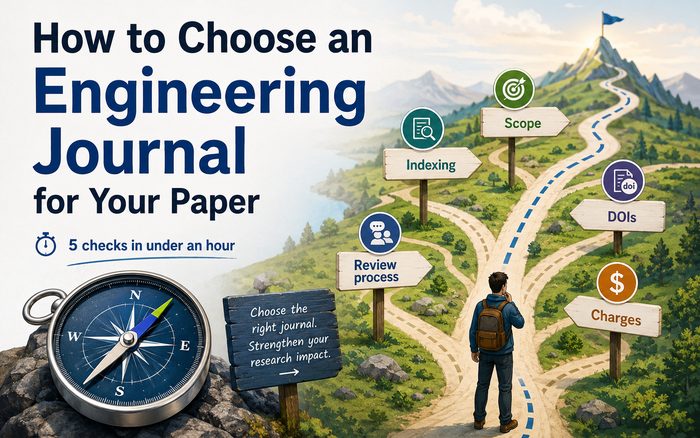
Choose an engineering journal by checking five things: whether your subject fits its scope, whether the databases it claims can be verified, whether the review process is described, whether every article gets a DOI, and what the charges are and when they fall due. All five are checkable in under an hour, and doing it before you finish writing saves reformatting later.
Most authors choose a journal the way they choose a restaurant on a bad day — whichever one is in front of them. Then they spend three months waiting for a rejection that was predictable on day one.
The single commonest reason a paper is rejected without ever reaching a reviewer is that it does not fit the journal. Editors are not being difficult; they are protecting reviewers’ time.
The check takes fifteen minutes: read the aim and scope, then open the two most recent issues and read the titles. Not the abstracts — the titles. If none of them sits anywhere near your subject, you have your answer.
A paper rejected on scope costs you three months and teaches you nothing. It is the only rejection that is entirely avoidable before you submit.
| # | Check | How to do it | Time |
|---|---|---|---|
| 1 | Scope | Aim and scope page, plus titles from two recent issues | 15 min |
| 2 | Indexing | Open each claimed database and search for the journal | 15 min |
| 3 | Review process | Find the page that describes it. If there is no such page, that is your answer | 5 min |
| 4 | DOIs | Open any recent article and look for one. Test that it resolves | 2 min |
| 5 | Charges | Find the amount and the stage at which it applies | 5 min |
At this engineering journal all five are on the site: indexing with verification links, the peer review and publication policy, a Crossref DOI on every article, and charges of 1,500 INR (Indian authors) or 55 USD (international) payable only after acceptance, with no submission fee.
A row of database logos on a homepage is an image file. It proves nothing. The check is to go to the database and search for the journal by name or ISSN.
Two things this catches. First, journals listing databases they were never in. Second, and more common, journals still displaying a logo for a database that dropped them years ago. Neither is visible from the logo itself.
This is why our Indexing Information page gives the direct link for each entry rather than a badge. If a journal will not give you the links, do the search yourself — it takes fifteen minutes for the whole list.
Three questions, and all three matter:
Our guide on open access versus subscription publishing explains why the timing of the charge tells you more than the amount.
One of these on its own is not proof of anything. Three of them together is a pattern.
Once you have a shortlist, check that your paper matches a category the journal actually publishes. This engineering journal takes original research articles, review articles, case reports and short communications, each with its own limits — a research article runs to no more than 15 pages.
Choosing the category before you write matters because it sets your length, your structure and sometimes your reference count. Writing first and categorising afterwards is how people end up cutting 2,000 words at the worst possible moment.
There is a question authors rarely ask: who do I want to read this? For a good deal of engineering research the useful readers are not other academics. They are practising engineers, consultancies, standards committees, regulators and small manufacturers — people who will act on the result rather than cite it.
Almost none of them hold journal subscriptions. If your work is meant to change how something is designed or tested, publishing it behind a paywall reaches the people studying the problem and misses the people solving it. That single consideration decides the open access question for many engineering papers before cost enters into it.
| Stage | Who controls it | Realistic |
|---|---|---|
| Editorial check | The editor | Days |
| Peer review | Two unpaid volunteers | Weeks |
| Your revision | You | One week here |
| Second review | The same reviewers | Days to weeks |
| Production and proofs | The publisher | Days |
The only row you control is your own. It is also the row that most often runs longest in real papers, because authors put reviewer comments aside for a month. A journal advertising a guaranteed number of days before it has seen your manuscript is promising something it cannot control either.
Submitting to a venue well outside your paper’s reach, being rejected, and repeating that down a ladder is a common strategy and an expensive one. Each cycle costs two to four months. Three cycles is a year in which the work was read by nobody.
One reach attempt is defensible if the paper genuinely might belong there. Three in sequence usually means the first assessment was wrong and never revisited.
The opposite failure is choosing whichever engineering journal responds fastest. Speed is not a quality, and a venue that publishes anything gives your work no signal at all. You will also find, later, that some institutions do not count publications from journals they cannot verify.
Whichever journal you settle on, read its author instructions from beginning to end once — not the section you think you need. That page sets your file format, page limit, abstract limit, keyword count, reference style, figure resolution and submission checklist.
At this engineering journal that is the Instructions to Author page: MS Word, no more than 15 pages, abstract no more than 300 words, 3 to 6 keywords, Vancouver references, figures at 75 or 155 mm and 300 dpi. Twenty minutes of reading, and every one of those decisions is made before you start writing rather than after.
Read the aim and scope, then read the titles in the two most recent issues. If nothing there resembles your subject, the answer is no — regardless of how good the paper is. Scope mismatch is the commonest desk rejection and the cheapest to avoid.
No. Simultaneous submission is prohibited by essentially every journal, including this one, and your cover letter has to state that the work is not under consideration elsewhere. Being found out is far worse than the weeks you save.
Not necessarily. A high-impact venue with a scope that only half fits your paper will reject it, and a year later you have nothing. Fit and readership matter more than the number for most papers.
About an hour, before you finish writing. That hour decides your format, your length limit and your reference style, so doing it afterwards means reformatting.
Read the rejection carefully — editors often name a better-suited venue. Then check the next journal properly before resubmitting, because the same mistake twice costs months.
Yes. A short presubmission enquiry with your title and abstract is normal and saves everyone time. Keep it to a paragraph.
Before you settle on a journal, read these together:
Created by Ananya Iyer • 08 Aug 2026
P-ISSN: 2664-8776
E-ISSN: 2664-8784

International Journal of Research in Engineering