P-ISSN: 2664-8776
E-ISSN: 2664-8784
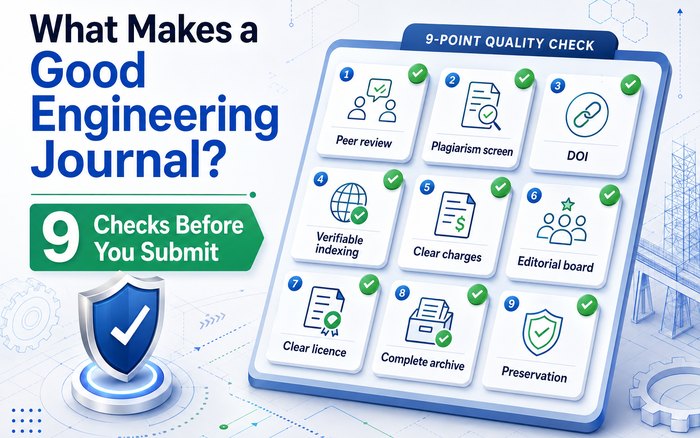
A good engineering journal describes its peer review process, screens for plagiarism, registers a DOI for every article, lists indexing you can verify yourself, states its charges before you submit, names a contactable editorial board, publishes under a clear licence, keeps a complete archive, and preserves its content. Every one of those is checkable from your desk in about half an hour.
That half hour is the best-value time you will spend on any engineering journal. It costs nothing, it happens before you commit anything, and it prevents the two outcomes authors actually fear: months lost to a journal that was never going to work out, and a publication that later turns out not to count.
| # | Check | What good looks like |
|---|---|---|
| 1 | Peer review described | A page saying who reviews, how many, and blinded how |
| 2 | Plagiarism screening | Named tool, and stated consequences |
| 3 | DOIs registered | Every article has one, and it resolves |
| 4 | Verifiable indexing | Links to each database, not logos |
| 5 | Charges stated up front | Amount and the stage they fall due |
| 6 | Named editorial board | Real names with affiliations, and a contact route |
| 7 | Clear licence | Which Creative Commons licence, and who keeps copyright |
| 8 | Complete archive | Every issue since the journal began, still reachable |
| 9 | Preservation | Content stored in more than one place |
Not “we follow rigorous peer review” — the specifics. How many reviewers, blinded which way, who takes the final decision. If a journal cannot describe its own process in a paragraph, it may not have one.
This journal sets it out on the peer review and publication policy page: an initial editorial read, then two reviewers under double-blind review, with the Subject Editor deciding. Our guide on what peer review involves explains what reviewers are asked to assess.
The screening matters less than the stated consequence. A journal that says what happens has thought about it. Here, plagiarism found before or after publication leads to the paper being retracted and the authors blacklisted.
Open any recent article and look. Then test that the DOI actually resolves — put it after https://doi.org/ and see whether it lands on the paper. Registration is a paid activity, so a publisher who has not joined a registration agency has no DOIs to give.
Every article in this engineering journal is registered with Crossref under the prefix 10.33545. Our guide on what a DOI is explains why its absence is a genuine warning sign.
This is where the most damage is done. Logos are images. The check is to open the database and search. Two failures show up: databases the journal was never in, and databases that dropped it while the logo stayed. Neither is visible from the badge.
Our Indexing Information page gives a direct link for each entry so you can check every one without asking us.
Both numbers matter: how much, and when. Here there is no submission fee, and an article handling and processing charge of 1,500 INR (Indian authors) or 55 USD (international) falls due only after acceptance.
A charge that falls after peer review cannot influence the review decision. That sequence is worth more than the amount.
Names with affiliations, and a way to reach the journal. A board listed without institutions, or a contact page with only a web form, is worth a second look. People have found their own names listed on boards they never agreed to join.
You should be able to find out, before submitting, exactly what readers may do with your paper and whether you keep the copyright. This journal applies CC BY-NC and authors retain copyright — the terms are on the content licensing policy page.
Open the archives and look for gaps. A journal that began in 2019 should have every issue since 2019 reachable, and older articles should still open at their original addresses. Missing years usually mean a platform migration that lost content — which tells you what could happen to your paper.
Ask what happens if the website disappears. Electronic content here is stored on separate sources with a backup copy, and every article is also kept in printed form. It is an unglamorous check that matters more the longer your paper needs to stay findable.
Run these in this sequence. Most problem journals fail one of the first three, and then you can stop.
Twenty-five to thirty minutes for a journal you are considering seriously. Set against three months waiting for a decision, it is the cheapest work in the whole process.
Two things people expect to see here and will not.
Not because metrics are worthless, but because the number is the easiest thing on a journal website to fake, and the hardest for an author to verify. Several organisations sell official-sounding “impact factors” that have no relationship to the Clarivate metric people assume is meant. A journal quoting a figure from a body you cannot identify has told you something — but not what it intended.
A fast decision is not evidence of a weak process; it usually means two reviewers happened to be free. What matters is whether the process is described and followed, not how many days it took.
This is the common case, and it does not have a single answer. Which check failed matters:
| Failed check | How serious |
|---|---|
| Indexing cannot be verified | Serious. It is the claim most often inflated |
| Charges not visible | Serious. Every legitimate journal states them |
| Review process vague | Serious. The core of what a journal does |
| No preservation statement | Minor on its own; matters more for long-lived work |
| Archive has a gap | Ask why. Often a platform migration, sometimes worse |
| Board without affiliations | Worth an email before you decide |
One failure in the bottom half is a question to ask. One in the top half is a reason to look elsewhere.
A described peer review process, plagiarism screening, registered DOIs, indexing you can verify yourself, charges stated openly before submission, a named and contactable editorial board, and a clear licence. All seven are checkable in about half an hour.
No. An ISSN is an administrative identifier, not an assessment. Newsletters have ISSNs. Check the review process, indexing and DOIs separately.
Go to the database and search for the journal by name or ISSN. A logo on a homepage is an image file and proves nothing — including when the journal was once indexed and has since been dropped.
Not automatically, but read it carefully. Flattery about a paper you have not written, a guaranteed turnaround, and an unnamed 'impact factor' in the same email are three signs of a mass mailing.
Not on its own — speed depends on how quickly two reviewers reply. What should worry you is a fixed turnaround promised before anyone has seen the manuscript.
Treat that as the answer. Every legitimate engineering journal states its charges and the stage at which they fall due, on a page you can find without asking.
How to verify a journal for yourself:
Created by Rohit Malhotra • 08 Aug 2026
P-ISSN: 2664-8776
E-ISSN: 2664-8784

International Journal of Research in Engineering