P-ISSN: 2664-8776
E-ISSN: 2664-8784

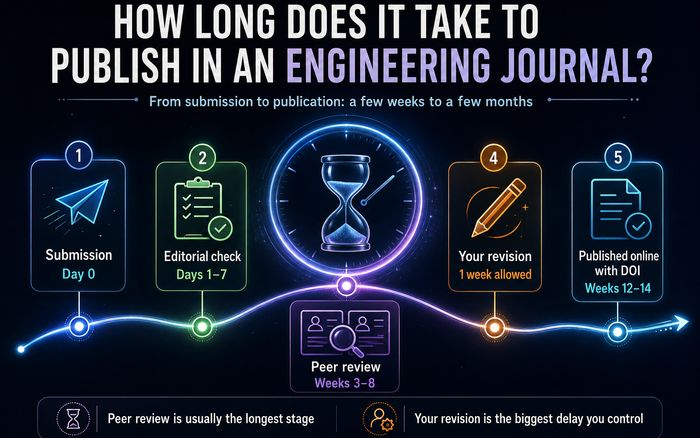
From submission to publication in an engineering journal usually takes a few weeks to a few months. The editorial check takes days, peer review by two reviewers takes weeks, your revision is due within one week, and production adds a little more. The one stage you control — your own revision — is also the one that most often runs longest.
Authors want a number from every engineering journal they consider. The honest answer is that no journal can give one before it has seen your manuscript, and a journal that does is telling you something about its process rather than about its speed.
| Stage | Who controls it | Typical | Can it be sped up? |
|---|---|---|---|
| Acknowledgement | Automatic | Immediate | — |
| Editorial check | The editor | Days | No |
| Finding reviewers | The editor | Days to weeks | No |
| Peer review | Two unpaid volunteers | Weeks | No |
| Your revision | You | One week allowed | Yes |
| Second review | The same reviewers | Days to weeks | No |
| Proofreading | You | Days | Yes |
| Publication | The publisher | Days | No |
Look at that table again and notice how few rows you can affect. Two — your revision and your proof check. Everything else depends on people whose time you do not control.
Reviewers are working researchers who review unpaid, alongside their own teaching, research and deadlines. For your paper an editor has to find two of them who are in the right sub-field, free, and willing.
That is where most of the elapsed time goes, and it is not inefficiency. A reviewer who reads your paper properly needs a clear evening. Finding two such evenings in two different people’s calendars is genuinely the slow part.
Here is the uncomfortable part. The revision window at this engineering journal is one week. In practice, revisions routinely take a month or more, because the comments arrive, the author reads them, feels discouraged, and sets them aside.
If you do one thing with this article, do this: read the reviewer comments the day they arrive, even if you cannot start work for another two days. The reading takes an hour and tells you the size of the job. Most reports turn out to be smaller than they felt on first sight, and our guide on responding to reviewer comments shows the format that clears the second round quickly.
Some engineering journals advertise publication within a fixed number of days. Work through what that requires: an editor must read the paper, identify two qualified reviewers, secure their agreement, give them time to read carefully, collect both reports, send them to you, receive your revision, have it checked again, and produce the article.
Guaranteeing all of that in seven days, before the manuscript has even been seen, is a promise about the process rather than about the speed. Something in that list is not happening.
Speed on its own is not a warning sign. A paper can clear review in three weeks because both reviewers happened to be free. The signal is a fixed period promised in advance, which nobody can control.
A polite enquiry after a reasonable interval is normal. Quote the reference number from your acknowledgement, keep it to a paragraph, and ask about status rather than for a decision. Weekly emails do not move a paper forward and they do consume the editor’s time.
If something has genuinely stalled — months with no acknowledgement, no response to two enquiries — that is worth raising with the Managing Editor, whose contact details are on the instructions page.
There is a step authors often miss when they estimate timelines. Acceptance is not publication, and publication has more than one moment:
| Milestone | What exists at that point | Can you cite it? |
|---|---|---|
| Accepted | A decision, no article | No |
| Proof approved | A final version, not yet posted | No |
| Published online | A live article with a DOI | Yes |
| Published in print | The printed issue | Yes |
| Appearing in databases | Indexed records | Yes — but this lags |
The gap that surprises people is the last one. Your article is live and citable the day it appears online with its DOI. Its appearance in indexing databases can lag by weeks, because those systems harvest on their own schedules. If a form asks for a database record and you cannot find one yet, the article is still published — give the DOI.
If you have a fixed date — a thesis submission, a promotion round, a funding report — work backwards and be pessimistic:
The mistake to avoid is choosing a journal for its promised speed rather than its fit. A fast rejection from the wrong venue is slower than a normal decision from the right one, because you start again from zero.
| Delay | Root cause | Preventable? |
|---|---|---|
| Weeks with no acknowledgement | Incomplete submission — the file never entered the queue | Yes |
| Desk rejection after three weeks | Scope mismatch | Yes |
| Long silence during review | Reviewer could not be secured, or dropped out | No |
| A second full review round | A vague or incomplete response to comments | Yes |
| Production delay | Figures below 300 dpi that must be re-supplied | Yes |
Four of those five are within your control, and all four are decided before you press submit.
Here is how a straightforward paper actually moves through an engineering journal, with no disasters and no unusual luck. Treat it as a shape rather than a schedule:
Three to four months, with one round of revision, nothing going wrong. A paper that needs two rounds or loses a reviewer runs longer, and one that clears with minor revisions can be considerably shorter.
A few weeks to a few months. An editorial check takes days, two reviewers take weeks, you get one week to revise, and production adds a little more. No honest journal can promise a fixed number before it has seen your manuscript.
Because they are not reviewing the paper. Two independent experts cannot be found, briefed, and given time to read within a week as a guaranteed service. A fixed short turnaround advertised in advance is a claim about the process, not about efficiency.
Peer review is usually the longest stage the journal controls. But in real papers the longest single delay is often the author's own revision — the window here is one week, and papers routinely sit for a month.
Yes, after a reasonable interval, quoting the reference number from your acknowledgement. Asking weekly does not speed anything up and does use the editor's time.
No. The charge falls after acceptance, so it cannot affect the review timeline at all. Any journal where paying earlier moves you forward is selling something other than review.
One week at this journal. Read the comments the day they arrive even if you begin work later — the reading takes an hour and it tells you the size of the job.
The stages that decide the timeline:
Created by Arjun Bhatt • 08 Aug 2026
P-ISSN: 2664-8776
E-ISSN: 2664-8784

International Journal of Research in Engineering