P-ISSN: 2664-8776
E-ISSN: 2664-8784

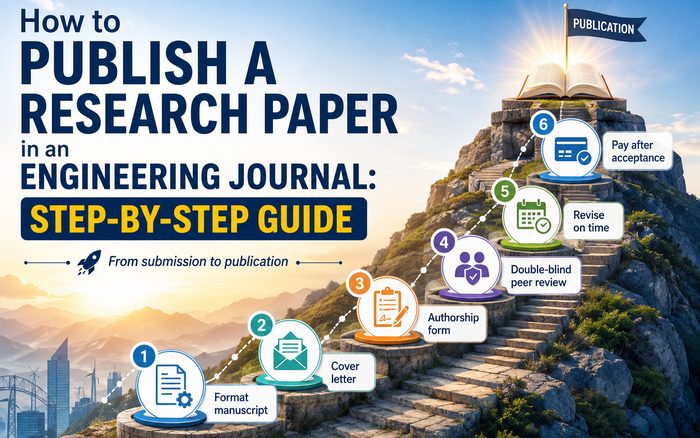
To publish a research paper in an engineering journal you prepare the manuscript in the journal’s required format, submit it with a cover letter and an authorship responsibility form, pass double-blind peer review by two reviewers, return your revision within the deadline, and pay the processing charge only after acceptance. The whole cycle usually runs from a few weeks to a few months.
That is the short version. The longer version below is the process as it actually runs at the International Journal of Research in Engineering, with the real limits and charges rather than general advice. Most engineering journals work the same way; only the numbers differ.
Papers get rejected for being incomplete far more often than for being wrong. Before you open a blank document, you should be able to answer three questions in one sentence each: what did you set out to find, how did you test it, and what did you find. If any of those three needs a paragraph, the work is not finished yet.
This journal accepts original research articles, review articles, case reports and short communications. Most engineering journals accept the same four categories. Pick the type before you write, because each has a different length limit and a different expected structure. Writing 6,000 words and then discovering the category caps you at fewer is a painful way to learn this.
This step takes fifteen minutes and saves weeks. Read the aim and scope, then read the titles in the two most recent issues. If nothing there resembles your subject, you have your answer before you submit anything.
While you are there, check four other things:
A journal that will not tell you its charges, its review process and its indexing before you submit has told you something useful anyway.
Formatting is not a matter of taste and it is not something to fix later. The specification here is short enough to set up before you write a word:
| Requirement | Specification |
|---|---|
| File format | MS Word (.doc or .docx) |
| Language | English |
| Length | Not more than 15 pages |
| Abstract | Not more than 300 words |
| Keywords | 3 to 6, immediately after the abstract |
| References | Vancouver style, numbered in citation order |
| Figures | 75 mm or 155 mm wide, 300 dpi |
The abstract deserves particular care because it is the only part many people will ever read. Keep it under 300 words, put the actual numbers in it rather than describing them, and do not use abbreviations or citations there. Our guide on writing an abstract works through this in detail, including a worked example.
One thing authors get wrong repeatedly: figures. A screenshot pasted from a presentation is typically 72 dpi. It looks fine on screen and cannot be printed at 300 dpi. Export figures from the original software at the required width and resolution, not from a slide deck.
Submission is not just the manuscript. Three documents go together, and a submission missing any one of them cannot start:
Sample files for all three are downloadable from the Instructions to Author page. Submit through the manuscript submission link or by e-mail; you will get an acknowledgement with a reference number. Keep that number — every later enquiry becomes faster if you quote it.
Your paper first goes to the subject editor, who checks it against editorial policy and a minimum quality level. Papers that pass go to two reviewers under a double-blind process: the reviewers do not know who wrote the paper, and you will not know who reviewed it. All identifying information is stripped from the document before it goes out.
Reviewers at an engineering journal are not looking for reasons to reject you. They are answering one question: can I tell exactly what was done, and do the results support the conclusion? Most negative reports come down to a method described too thinly to judge — no replication count, no design named, no control, statistics without a significance level. None of those need more experiments. They need you to write down what you already did. Our guide on what peer review involves explains what reviewers are actually asked to assess.
Comments come back anonymised, and the revised manuscript is expected within one week. That deadline is tighter than most authors expect, which is why the revision stage is where papers stall.
Write a response document that answers every point in order — including the ones you disagree with. A reasoned disagreement is respected. Silence is not: a revision that quietly ignores half the comments is a common way to turn a “major revision” into a rejection. Our guide on responding to reviewer comments shows the format that works.
The revision goes back to the same reviewers, and the Subject Editor takes the final decision.
Accepted papers come back to you in ready-to-print format for proofreading. Read that proof properly — once the article is published, no changes are made, and any error that survives is yours to live with.
The processing charge falls at this point, not earlier:
| Author | Charge |
|---|---|
| Indian authors | 1,500 INR (w.e.f. 01.10.2022) |
| International authors | 55 USD (w.e.f. 01.10.2022) |
There is no submission fee. The charge covers formatting, the publication process and hosting; the journal receives no governmental or non-governmental funding. The sequence matters more than the amount: a charge that falls after peer review cannot influence the review decision.
Articles are published online and in print, and a download link is e-mailed to you. This is the point at which your work formally becomes part of the engineering journal literature. Every article receives a DOI, so it stays citable even if web addresses change later. Publication is open access under a Creative Commons Attribution-NonCommercial (CC BY-NC) licence, and you keep the copyright to your own work.
These are the delays we see most often at this engineering journal, in rough order of how much time they cost authors:
There is no single answer, and any journal that promises one should worry you. Realistically: an editorial check takes days, peer review by two reviewers takes weeks, you get one week to revise, and production adds a little more. A few weeks to a few months is the honest range. What you control is the revision turnaround — sitting on reviewer comments for a month is usually the longest delay in the whole process.
At this journal there is no submission fee. An article handling and processing charge applies only after your paper has passed peer review and been accepted: 1,500 INR for Indian authors and 55 USD for international authors, in effect since 1 October 2022. Engineering journals differ enormously on this, so check before you submit, not after.
Yes. Reviewers assess the work, not the designation of the person who did it. A great deal of published engineering research comes from postgraduate and doctoral students. What matters is that the method is sound and the reporting is complete.
Not more than 15 pages for a research article at this journal. Review articles, case reports and short communications have their own limits, all set out on the Instructions to Author page.
Read which stage rejected you. A one-line editorial note means the paper never reached review — usually scope or formatting, both cheap to fix. Reviewer reports mean the science was read, and those reports are the most detailed feedback your paper will ever get for free. Fix the substantive objections before sending it anywhere else.
If you are working through a first submission, these cover the next decisions:
Created by Akhil Gupta • 27 Jul 2026
P-ISSN: 2664-8776
E-ISSN: 2664-8784

International Journal of Research in Engineering