P-ISSN: 2664-8776
E-ISSN: 2664-8784

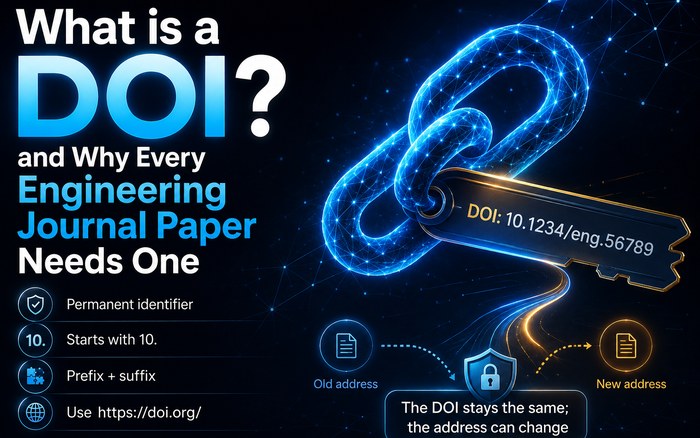
A DOI is a permanent identifier assigned to a document so that it can be found even if its web address changes. It always begins with 10. followed by a publisher prefix, a slash, and a suffix chosen by the publisher. Putting https://doi.org/ in front of a DOI opens the document wherever it currently lives. The DOI never changes; the address behind it can.
Every article in this engineering journal carries one, and if you are choosing where to send a paper, whether the journal registers DOIs is one of the few checks that takes seconds and tells you something real.
Every DOI has exactly two parts, separated by a slash. Here is a real one from this journal:
10.33545 / 26648776.2026.v8.i1a.153
| Part | Value | What it is |
|---|---|---|
| Prefix | 10.33545 | Always starts with 10. — the rest identifies the publisher, assigned by the registration agency |
| Suffix | 26648776.2026.v8.i1a.153 | Chosen by the publisher, unique within that prefix |
The suffix carries no meaning a machine relies on — it can be any string — but many publishers make it readable. This one is built from information you already know:
So a DOI from this engineering journal can be read at a glance. That is a convenience, not a rule — never assume a DOI from another publisher is structured the same way.
Prefix the DOI with the resolver address and open it:
https://doi.org/10.33545/26648776.2026.v8.i1a.153
The resolver looks up where that document currently sits and redirects you there. This is the correct way to link to a paper in a reference list, an email, a thesis or a grant report — it will still work years later, when the publisher’s own URLs have changed.
Link to the DOI, not to the page you happen to be looking at. A copied browser address is a snapshot of today’s site structure. A DOI is a promise to keep working after that structure changes.
Web addresses decay, and engineering journal archives are no exception. Journals redesign their sites, move platforms, change domains, get acquired, or reorganise their archives. Every one of those events breaks the plain URLs people pasted into reference lists — and a citation that leads nowhere cannot be checked.
A DOI solves this with one layer of indirection. The identifier is fixed and public; the address it maps to is a record the publisher maintains. When the article moves, the publisher updates the record, and every reference list in the world that used the DOI keeps working without anyone touching it.
This is why journals, funders, universities and databases now treat a registered DOI as a basic requirement rather than a bonus.
This explains a common misunderstanding: DOI registration is a paid membership activity, not something that happens automatically when an article goes online. A publisher that does not join and does not deposit has no DOIs to give.
A DOI is an identifier, not a quality mark, and no engineering journal should imply otherwise. It certifies nothing about the work it points to.
Treat a DOI as a minimum, not a recommendation. Its absence is a genuine warning sign; its presence means the publisher did one thing properly. The things that actually indicate quality — a described review process and indexing you can verify yourself — have to be checked separately.
| Plain web link | DOI | |
|---|---|---|
| Survives a site redesign | No | Yes |
| Survives a domain change | No | Yes |
| Machine-readable metadata attached | No | Yes (title, authors, year, references) |
| Counted by citation-tracking services | Usually not | Yes |
| Works in a reference list ten years later | Rarely | Yes |
The last row is the one authors underestimate. A thesis submitted in 2019 with plain URLs in its bibliography already has dead links today. The same bibliography written with DOIs still resolves.
Every published article is registered with a Crossref DOI under the prefix 10.33545. Registration happens as part of publication, not as an optional extra, which means the article is citable from the day it appears rather than at some later point.
Articles are also free to read from the day they are published, so a DOI from this journal resolves to a full text anyone can open — not to a paywall asking for money. That combination is worth checking on any engineering journal you are considering: a DOI that lands on a payment screen is doing half a job.
“DOI: 10.33545/…” on its own is fine in a printed reference list, but in anything digital it should be the full resolvable form so a reader can click it. Both are acceptable under Vancouver; only one is useful on screen.
The old resolver address still redirects, but the current form is https://doi.org/. Reference managers built years ago sometimes still emit the old one. Update it.
Reference managers import DOIs from databases, and databases occasionally carry errors. If you have not clicked it, you do not know it works. This is a two-minute check across a whole reference list and it prevents the most avoidable kind of correction after publication.
This journal uses Vancouver referencing. The DOI goes at the end of the reference:
Aho M, Irshad B, Ackerman SJ, Lewis M, Leddy R, Pope T, et al. Correlation of sonographic features with tumor grade. J Clin Ultrasound. 2013 Jan;41(1):10-7. DOI: 10.1002/jcu.21990
Two habits worth keeping:
Three ordinary explanations, in order of likelihood:
A DOI that has never worked is a different problem from one that has stopped working, and it is worth telling the journal which you are seeing.
Digital Object Identifier. It is a permanent identifier assigned to a document so it can be found even after its web address changes. The system is an international standard, ISO 26324, and for research articles the registration agency is usually Crossref.
No. A DOI has to be registered and paid for by the publisher, so it is a choice rather than an automatic property of publication. Every article in this engineering journal is registered with a Crossref DOI under the prefix 10.33545.
No. A DOI identifies a document and says nothing about how it was reviewed. Preprints, datasets, reports and conference abstracts all carry DOIs. Judge quality by the review process and verifiable indexing instead.
Put https://doi.org/ in front of it and open it in a browser. For example, https://doi.org/10.33545/26648776.2026.v8.i1a.153 redirects to the article's current page.
Usually it is a typo — re-copy it from the source rather than retyping, because suffixes mix letters and digits. It can also mean the DOI has not been registered yet, which happens with very recently published articles. If it still fails, tell the journal.
The DOI itself does not change once assigned. What changes is the web address behind it, which the publisher updates. That is the entire point of the system.
How the identifiers fit together:
Created by Nikhil Gupta • 23 Jul 2026
P-ISSN: 2664-8776
E-ISSN: 2664-8784

International Journal of Research in Engineering