P-ISSN: 2664-8776
E-ISSN: 2664-8784

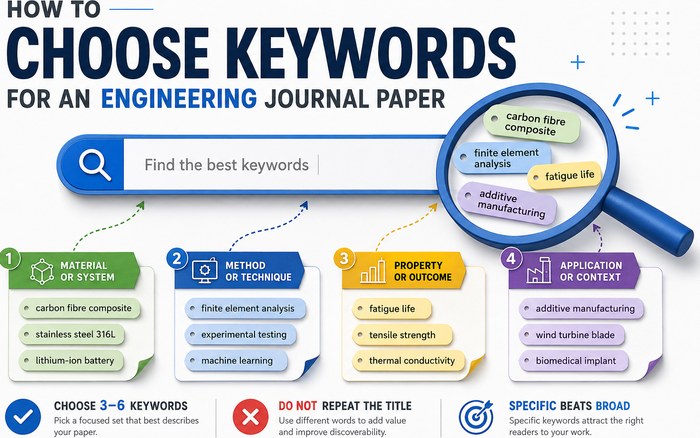
Choose 3 to 6 keywords that cover the four things a reader searches on — the material or system, the method, the property measured, and the application — and never repeat words already in your title. Keywords are how people who have never heard of your paper find it, and most authors spend thirty seconds on them.
For an engineering journal paper this is the cheapest part of a manuscript to get right and one of the easiest to waste. A paper with generic keywords is competing with millions of records; the same paper with specific ones reaches the handful of people who needed it.
Two different systems read your engineering journal keywords, and they use them differently:
So the keyword line is not a formality for the database alone. Working out what your readers type is the same exercise as working out what your abstract should say.
Almost every useful engineering journal keyword set covers these four. Pick one or two from each:
| Axis | Question it answers | Examples |
|---|---|---|
| Material or system | What was studied? | carbon fibre composite, austenitic stainless steel, induction motor |
| Method or technique | How was it studied? | finite element analysis, ultrasonic testing, response surface methodology |
| Property or outcome | What was measured? | fatigue life, thermal conductivity, chloride ingress, energy efficiency |
| Application or context | Where does it apply? | offshore structures, electric vehicles, coastal exposure, additive manufacturing |
A paper titled “Effect of fibre loading on tensile properties of jute-epoxy composites” already contains the material and the property. So the keywords should spend their slots elsewhere: natural fibre composite, hand lay-up, interfacial bonding, automotive interior panels, sustainable materials.
Repeating the title. It is the single commonest waste, and it happens because the title words are the ones already in your head.
Title: Corrosion behaviour of galvanised steel in marine environments
Keywords: corrosion, galvanised steel, marine environment — three slots, zero new information.
Better: zinc coating, salt spray testing, electrochemical impedance, coastal infrastructure, service life prediction. Now the paper is findable by five routes it was invisible on before.
| Too broad | Better | Why |
|---|---|---|
| engineering | additive manufacturing | The first matches everything and distinguishes nothing |
| materials | shape memory alloy | Names what you actually worked on |
| testing | accelerated life testing | A searcher looking for this will not find "testing" |
| analysis | computational fluid dynamics | Same problem, same fix |
| optimization | multi-objective optimization | One extra word, a far smaller and more relevant pool |
The instinct behind broad engineering journal keywords is understandable — you want the widest possible audience. It backfires. Ranking for “materials” is impossible; being the clearest result for “jute-epoxy interfacial bonding” is achievable, and those are the readers who will actually cite you.
Take a real-sounding paper and choose its keywords properly. The study: a fatigue test on friction stir welded aluminium joints, measuring how weld speed changes crack initiation life, aimed at aerospace panel joints.
Effect of welding speed on fatigue crack initiation in friction stir welded AA6061 joints
Welding speed, fatigue crack initiation, friction stir welding, AA6061. All four are indexed already. None of them should be a keyword.
| Axis | Keyword chosen | Why it is not in the title |
|---|---|---|
| Material | aluminium alloy | A reader searching the general class, not the specific grade |
| Method | tool rotational speed | A parameter varied in the study but never named in the title |
| Property | S-N curve | How fatigue data is presented and searched for |
| Application | aerospace joints | Who needs this result |
| Extra | residual stress | A mechanism discussed in the paper and searched heavily |
Five keywords, five new routes to the paper, zero overlap with the title. That took about four minutes.
The four axes assume an experimental paper. Two other article types need a slightly different approach:
If the paper is already written, run this before you submit. It is faster than choosing from scratch and it catches the two failures that matter.
Most manuscripts fail step 1 and step 3. Fixing just those two is the whole exercise.
It is worth being clear about the limits. Good keywords make a findable paper more findable. They do not rescue a paper nobody wants, they do not compensate for a vague title, and they will not put you in front of readers if the abstract does not hold their attention once they arrive.
Think of them as the last ten percent of discoverability, applied to a paper that has already earned the other ninety. That is still worth four minutes of your time — but it is four minutes, not a strategy.
At this engineering journal, keywords go immediately after the abstract, before the introduction, and there should be 3 to 6 of them. Two practical points:
The full specification, along with the 300-word abstract limit, is on the Instructions to Author page. Our guide on writing an abstract covers how the two work together.
Between 3 and 6 at this journal, placed immediately after the abstract. Fewer than three wastes the field; more than six dilutes it, and some indexing systems simply truncate the list.
No. Search systems index the title already. Every keyword that repeats a title word is a slot you have thrown away.
Yes, and it usually should be. Multi-word phrases such as fatigue crack propagation match how people actually search far better than a single generic word.
Only alongside the expanded form, never instead of it. Give both if the abbreviation is genuinely standard in your field, because different readers search for different forms.
Indirectly. The keyword field is used by indexing databases; Google reads your title, abstract and full text. Choosing terms your readers actually use helps in both places, because you naturally repeat them in the text.
Immediately after the abstract, before the introduction. This journal asks for 3 to 6, separated by commas.
Where keywords fit with the rest of the front matter:
Created by Rahul Jha • 21 Jul 2026
P-ISSN: 2664-8776
E-ISSN: 2664-8784

International Journal of Research in Engineering