P-ISSN: 2664-8776
E-ISSN: 2664-8784

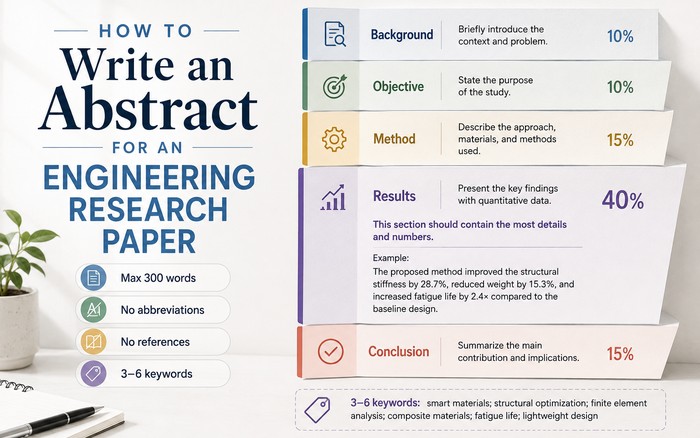
An abstract for an engineering journal should be no more than 300 words, contain the gist of the whole study, and use no abbreviations and no references. Order it as background, objective, method, results and conclusion, give results the most space, put real numbers in, and follow it with 3 to 6 keywords.
The abstract is the most-read and least-carefully-written part of most engineering journal papers. It is what appears in search results, in indexing databases and in the reference lists of people deciding whether to read you. Getting it wrong costs more readers than any other single mistake.
These are not stylistic preferences. A manuscript that breaks them goes back before a reviewer sees it. The full specification is on the Instructions to Author page.
Abstracts run out of room because background eats the space. A workable split:
| Part | Words | What it must answer |
|---|---|---|
| Background | 30–50 | Why does this problem matter, and what is unresolved? |
| Objective | 20–30 | What exactly did this study test? |
| Method | 50–70 | What material, what test, what conditions, how many samples? |
| Results | 80–120 | The actual numbers, with units and significance |
| Conclusion | 30–50 | What should a reader now do differently? |
Results get the largest share. That is the part nobody can get anywhere else, and it is the part most abstracts shortchange.
This single change improves more engineering abstracts than anything else. Compare:
“The modified composite showed significantly improved tensile strength compared with the control.”
“Tensile strength rose from 214 to 268 MPa (25.2%) at 15 wt% fibre loading, with a standard deviation of 6.4 MPa across five specimens.”
The second sentence is barely longer and carries the entire finding. It is also what a database, a citation or an AI assistant can actually quote. Give the level, the effect size, the unit and the spread.
Follow the journal’s unit conventions here too: SI units, a space between number and symbol (10 mg, not 10mg), and a zero before the decimal point (0.01).
Results published in an engineering journal are condition-bound. A fatigue life measured at 25 °C in dry air does not transfer to a humid environment, and readers know it. An abstract that omits the material, the loading and the environment is far less useful and far less likely to be cited by someone working on a comparable problem.
Include: the material or system and its grade, the test method or standard, the conditions, the number of specimens or runs, and the software where simulation was used. That is usually two sentences.
The abstract below is illustrative — the figures are invented to demonstrate structure, not taken from a published study. It runs to just over 200 words and covers all five parts.
Corrosion of reinforcing steel remains the dominant durability failure in coastal concrete structures, and surface treatments are widely recommended but seldom compared under identical exposure. This study tested whether a silane-siloxane surface treatment reduces chloride ingress in concrete more effectively than a conventional acrylic coating. Concrete cubes of grade M30 were cast with a water-cement ratio of 0.45, cured for 28 days, and divided into three groups: untreated control, acrylic-coated, and silane-siloxane treated. Specimens were exposed to a 3.5% sodium chloride solution in wet-dry cycles for 90 days, with six specimens per group. Chloride penetration depth averaged 12.4 millimetres in the control, 8.1 millimetres under the acrylic coating and 4.7 millimetres under the silane-siloxane treatment, a reduction of 62% relative to the control and 42% relative to the acrylic coating. Compressive strength differed by less than 3% across the three groups, indicating that the treatments acted on surface permeability rather than on the bulk matrix. Silane-siloxane treatment therefore offers substantially better chloride resistance than acrylic coating at comparable cost, and is recommended for coastal exposure. Results should be confirmed under longer exposure periods and on higher-grade concrete before wider specification.
Note what it does: names the material, grade, mix, curing and exposure; gives three measured values with units; reports the comparison as a percentage; explains the mechanism in one sentence; states a recommendation; and marks its own limit. No abbreviation, no citation.
The abstract is the only part of your paper that leaves the journal. Once an engineering journal publishes you, that paragraph is copied into indexing databases, search results, reference managers and, increasingly, into the answers AI assistants give when someone asks a question in your field. The full text stays behind a click; the abstract goes everywhere.
That has a practical consequence. A reader deciding whether to open your paper is deciding on those 250 words alone, with no figures, no tables and no context. An abstract that says “results are discussed” gives them nothing to decide on. One that says “chloride penetration fell from 12.4 to 4.7 millimetres” gives them a reason.
Some journals want labelled sections — Background:, Methods:, Results:. This engineering journal does not: the abstract is one continuous paragraph. The structure is still there, but it lives in the order of your sentences rather than in labels.
That makes the transitions matter. Each sentence should hand over to the next without a heading to do the work. In practice this means one sentence of background, one of objective, one or two of method, two or three of results, one of conclusion — in that order, every time.
Four sentences of context, one sentence of method, no numbers, and a conclusion that could have been written before the study started. This is the commonest failure. The fix is arithmetic: cut background to two sentences and spend the recovered words on results.
“The CFRP-strengthened RC beams were tested under UTM loading per ASTM D3039 to determine UTS and modulus.” Every one of those has to be written out. It reads longer, and that is the point — a reader outside your immediate sub-field can follow it.
An abstract claiming a general finding from a single test condition. Reviewers compare the abstract against the results, sentence by sentence, and a gap between them costs you more credibility than a modest claim ever would.
Keywords are how your paper is found by people who have never heard of it. Two rules:
Avoid single generic words such as “engineering” or “materials” on their own. They match millions of records and distinguish nothing.
In an engineering journal abstract these can almost always go without losing meaning:
Not more than 300 words at this journal. Most papers do the job in 200 to 250. The limit is a hard one — a longer abstract goes back before it reaches a reviewer.
No. Write terms out in full, however long they are. FEA becomes finite element analysis. You introduce the abbreviation later, in the main text.
No. If a comparison with earlier work is essential, describe it in words without a citation number and put the reference in the introduction.
Between 3 and 6, immediately after the abstract. Spend them on terms your title does not already contain — the title is indexed anyway.
Not at this journal. It is a single unstructured paragraph. The structure is in the order of the sentences, not in labels.
Last. Every sentence in it should already exist, in longer form, somewhere in the paper. If you find yourself writing something new, the paper is incomplete.
The sections either side of the abstract:
Created by Varsha Gupta • 25 Jul 2026
P-ISSN: 2664-8776
E-ISSN: 2664-8784

International Journal of Research in Engineering