P-ISSN: 2664-8776
E-ISSN: 2664-8784

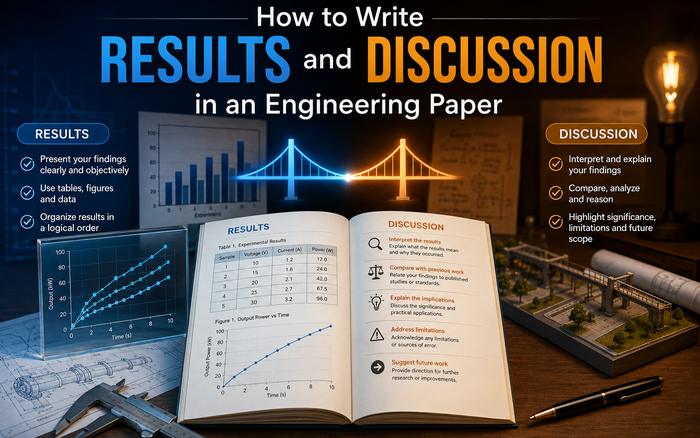
Results state what happened; Discussion explains what it means. Results are written in the past tense with no references and no interpretation. Discussion compares your findings with earlier work, offers a mechanism, admits the limits and says what follows. Mixing the two is the commonest structural fault reviewers report.
Authors submitting to an engineering journal often find these two sections the hardest, and the difficulty is usually not writing but deciding what belongs where.
| Results | Discussion | |
|---|---|---|
| Job | What happened | What it means |
| Tense | Past | Present and past |
| References | None | Yes — that is the point |
| Interpretation | No | Yes |
| Speculation | No | Carefully, and labelled |
| Limitations | No | Yes |
The single sentence that gets flagged most often looks like this: “Strength increased with fibre loading, which is consistent with the findings of Kumar et al. [12] and can be attributed to improved stress transfer.” That is a Results sentence carrying a Discussion sentence inside it. Split it.
Three rules cover almost everything:
“Tensile strength increased from 214 ± 6 MPa in the control to 268 ± 8 MPa at 15 wt% fibre loading (25.2%, p < 0.01), then fell to 241 ± 11 MPa at 20 wt% (Fig. 3).”
That sentence does the whole job: direction, magnitude, spread, significance, and a pointer to the figure. Nothing is interpreted and nothing is missing.
In an engineering journal paper, non-significant results, failed conditions and unexpected outliers are still results. Leaving them out makes the paper look tidier and makes it less true, and reviewers who notice a gap in a series will ask.
Be careful with language here. A difference that failed a significance test is not “a trend towards improvement”; it is a difference the data cannot support. That phrasing appears in a lot of submissions and reviewers are alert to it.
Move 2 is where most Discussion sections are thin. “The improvement may be due to better interfacial bonding” is a placeholder. If you have evidence — a fracture surface, a thermal trace, a model — use it. If you do not, say that the mechanism is not established by these data.
This engineering journal allows Results, Discussion and Conclusion to be combined where that reads better, and for some papers it genuinely does — particularly short studies where each result needs its interpretation immediately.
If you combine them, keep the distinction visible inside the paragraph: state the finding with its numbers, then interpret. What fails is a combined section where nobody can tell which sentences are observation and which are inference. A reviewer who cannot separate them will ask you to separate them.
| Show it as | When | Why |
|---|---|---|
| Text | Two or three values | A sentence is faster to read than a table of three rows |
| Table | Exact values matter, or many conditions | Precision, and easy comparison down a column |
| Figure | A trend, a shape, a relationship | The eye reads a curve faster than a column |
| Both | Almost never | The instructions specifically say not to present the same data twice |
That last row is a rule at this journal, not a preference: the same data should not appear in both a table and a graph. Choose the form that carries the point and reference it from the text.
“At 5 wt% the value was 228 MPa, at 10 wt% it was 251 MPa, at 15 wt% it was 268 MPa, at 20 wt% it was 241 MPa…” The table already says this. Give the direction, the peak and the significance, and point at the table.
“Strength improved considerably with fibre loading.” Considerably is not a quantity. Every claim in a Results section should carry a number a reader could check against the figure.
“The improvement confirms that natural fibres are a viable replacement for synthetic reinforcement.” That is a Discussion sentence, and a fairly large claim, sitting in Results where nobody can see the evidence for it yet.
For each major finding, in Discussion:
Repeat for the next finding. Then close the section with the overall limitations and what should be tested next. That shape works for most engineering journal papers and it stops the Discussion drifting into a general essay, which is the other common failure.
This worries engineering journal authors more than it should. A contradiction is interesting; hiding it is not. State it plainly, offer the most likely explanation, and say what would settle the question.
“This is lower than the 310 MPa reported by [14] for a similar system. The difference is most likely a consequence of curing schedule: [14] post-cured at 120 °C, against 80 °C here. Testing across a range of post-cure temperatures would establish whether this accounts for the whole gap.”
Three sentences: the difference, a mechanism, and a test. That is a stronger Discussion than any amount of agreement.
Authors leave limitations out fearing they invite rejection. The opposite happens. A reviewer who spots an unstated limit assumes you did not notice it; one who reads it stated assumes you understand your own work.
Keep it factual and short: what conditions you tested, how many specimens, what you could not measure, and what that means for how far the conclusion travels. Then narrow the conclusion to match — conclusions running ahead of the data are a common reason engineering journal papers are rejected after review.
One practical habit closes the gap between a good Discussion and a weak one: write the limitations paragraph first, before the rest of the section. It forces you to be honest about how far the data reaches, and everything you then claim is automatically bounded by it. Written last, limitations become an afterthought bolted on to conclusions that were already too wide.
Results state what happened. Discussion explains what it means. Results are in the past tense with no references; Discussion compares your findings with earlier work and therefore cites it.
At this journal Results, Discussion and Conclusion may be combined where that reads better. If you combine them, keep the distinction visible within the text — state the finding, then interpret it.
No. Point to the trend and the two or three numbers that carry the argument. Repeating a whole table in prose wastes words and makes both harder to read.
Past tense throughout. You are reporting what happened in an experiment that is over.
State it plainly, give the most likely explanation, and say what would settle it. A contradiction reported honestly is publishable; one that is quietly omitted is a problem waiting to be found.
Report it. Non-significant results are results, and hiding them distorts the record. State the test, the value and the threshold, and be careful not to describe a non-significant difference as a trend.
How to present and support the numbers:
Created by Elena Vasquez • 08 Aug 2026
P-ISSN: 2664-8776
E-ISSN: 2664-8784

International Journal of Research in Engineering