P-ISSN: 2664-8776
E-ISSN: 2664-8784

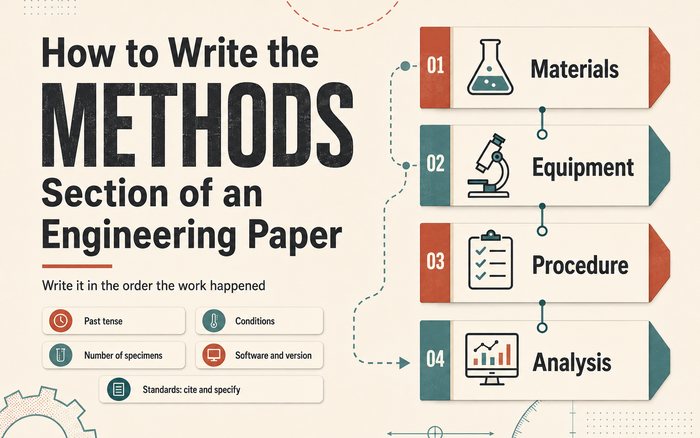
The Methods section must let a competent reader repeat your work. That means materials with grades and sources, equipment with models, the procedure with its conditions, the number of specimens, the experimental design and the statistical treatment — written in the past tense, in the order the work was done.
This is where most engineering journal papers are actually lost. Reviewers rarely reject an engineering journal paper because the result is wrong; they reject it because they cannot tell what was done well enough to judge whether it is right.
Could a competent engineer in my field, with access to similar equipment, repeat this experiment from what I have written?
For any engineering journal, that is the only question. Not “is it detailed” or “is it well written” — could someone repeat it. Every sentence either serves that or does not, and the ones that do not can go.
| Element | What to state | Common failure |
|---|---|---|
| Materials | Grade, standard, supplier, batch where relevant | “Aluminium was used” — which alloy? |
| Equipment | Make, model, capacity, calibration where it matters | “A universal testing machine” — whose, what capacity? |
| Specimen preparation | Dimensions, machining, surface finish, curing | Skipped entirely because it felt routine |
| Conditions | Temperature, humidity, loading rate, environment | Assumed to be obvious |
| Replication | How many specimens, how many runs | The most common omission of all |
| Design | Full factorial, randomised block, Taguchi — name it | “Experiments were conducted” |
| Analysis | Test used, significance level, software and version | Means reported with no test at all |
A Methods section that follows the actual sequence — material, preparation, test, measurement, analysis — is easier to follow and easier to check. A section organised by theme forces the reader to reconstruct the order themselves, and reviewers who have to reconstruct anything tend to ask for clarification.
Use subheadings if the work has distinct stages. Three short labelled blocks read far better than one long paragraph covering all three.
In an engineering journal paper, citing a standard saves you a page, and it is the right thing to do. But a standard usually permits a range of choices, and the reviewer needs to know which you made.
“Tensile tests were conducted according to ASTM E8.”
“Tensile tests were conducted according to ASTM E8 using flat sub-size specimens of 25 mm gauge length, at a crosshead speed of 2 mm/min, with five specimens per condition.”
The second version is one sentence longer and removes three questions a reviewer would otherwise have to ask. If you deviated from the standard in any way, say so and say why — an unexplained deviation discovered later is far worse than one declared.
Engineering journal Methods sections get bloated as often as they get thin, and the excess is usually one of these:
Here is a Methods paragraph as it usually arrives, and the same paragraph after the missing information is added. Nothing was re-tested between the two.
Composite specimens were prepared with different fibre loadings and tested for tensile strength using a universal testing machine. The results were analysed statistically.
Jute-epoxy composite specimens were prepared by hand lay-up at fibre loadings of 5, 10, 15 and 20 wt%, using untreated jute fabric (300 gsm, supplier X) and epoxy resin (LY556 with HY951 hardener, 10:1 by weight). Specimens were cured at 27 °C for 24 h followed by post-curing at 80 °C for 4 h, then machined to ASTM D3039 dimensions with a 25 mm gauge width. Five specimens per loading were tested on a 50 kN universal testing machine (make, model) at a crosshead speed of 2 mm/min at 27 ± 2 °C. Results were compared by one-way ANOVA at a 5% significance level using [software, version].
The second version answers every question a reviewer would have raised, and it took the author about twenty minutes because none of it required new work — it was all in the lab notebook.
The same principle applies but the details differ, and computational papers are rejected for thin methods just as often as experimental ones. State:
A simulation paper with no mesh independence study and no validation is asking the reviewer to take the results on trust, which is the one thing peer review exists not to do.
| Section | Tense | References? | Job |
|---|---|---|---|
| Introduction | Present / past | Yes | Why this problem, what gap |
| Methods | Past | Yes | What was done, repeatably |
| Results | Past | No | What happened |
| Discussion | Present / past | Yes | What it means |
| Conclusion | Present | Rarely | What follows |
The row that trips people is Results: past tense, no references. Interpretation and comparison with earlier work belong in the Discussion, and mixing them makes a reviewer suspect the findings are being oversold. Our guide on writing Results and Discussion covers that split.
Give your Methods section to a colleague who did not do the work and ask them to describe the experiment back to you. Not to comment on it — to describe it.
Every point where their description differs from what you actually did is a sentence to rewrite. This takes fifteen minutes and it finds the ambiguities you cannot see, because you know what you meant and they only know what you wrote. It is the single most effective review any engineering paper gets before submission.
The formatting requirements — units, symbols, figure specifications — are on the Instructions to Author page, and our pre-submission checklist covers the rest of the manuscript.
One last habit worth building: write the Methods section while you are still doing the work, not months afterwards. Every detail you will later struggle to recall is sitting in your notebook today, and the section written from memory is always the thinner one.
Enough for someone else to repeat the work: the materials with their grades and sources, the equipment with models, the procedure with conditions, the number of specimens or runs, the experimental design, and the statistical treatment with software versions.
Past tense, because you are describing what was done. Present tense creeps in when authors describe a standard rather than their own use of it — keep that distinction clear.
Either is accepted. Passive is traditional in engineering; active is often clearer. What matters is consistency and that the reader can tell who did what.
If removing a detail would stop someone repeating the work, keep it. If it would not, cut it. Room temperature at the time of an unaffected measurement is noise; the curing temperature of a specimen is not.
Cite the standard and state anything specific to your use of it — specimen dimensions, crosshead speed, number of repeats, any deviation. A citation alone leaves a reviewer unable to judge what you actually did.
The number of specimens or replications. It is one sentence and it generates more reviewer comments than any other missing item.
What comes next in the manuscript:
Created by Daniel Okafor • 08 Aug 2026
P-ISSN: 2664-8776
E-ISSN: 2664-8784

International Journal of Research in Engineering