P-ISSN: 2664-8776
E-ISSN: 2664-8784

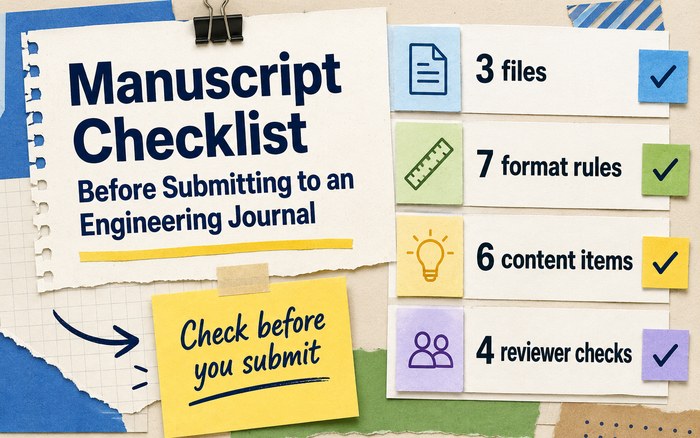
Before submitting to an engineering journal, check three files, seven format rules, six content items and four things reviewers ask for most. Working through this list takes about an hour and prevents the rejections that never reach a reviewer — the ones that cost months and teach you nothing.
Most engineering journal desk rejections are not judgements on the science. They are the consequence of something on this page being missed.
| File | What it must contain | Where to get the template |
|---|---|---|
| Cover letter | Work is original, not published before, not under consideration elsewhere. Optionally two suggested reviewers with affiliations | Downloadable sample on the Instructions to Author page |
| Authorship responsibility form | Signed | Same page |
| Complete manuscript | All figures with headings, all tables with headings or legends | Same page |
Send all three together. This is the most common incomplete-submission failure and the easiest to avoid: a manuscript arriving alone does not start a review, and nobody chases you for the missing files.
| # | Rule | Specification |
|---|---|---|
| 1 | File format | MS Word (.doc / .docx), English |
| 2 | Length | Not more than 15 pages |
| 3 | Abstract | Not more than 300 words |
| 4 | Keywords | 3 to 6, immediately after the abstract |
| 5 | References | Vancouver style, numbered in citation order |
| 6 | Figures | JPG/JPEG, 75 mm or 155 mm wide, 300 dpi, numbered in citation order |
| 7 | Tables | After the references, Arabic numerals, headings or legends |
Each of these takes under a minute to verify and each one, missed, can send the manuscript back before review. Two that catch people repeatedly:
The first page carries the title, all authors, affiliations, all author e-mails, and the corresponding author’s full address with phone number. After that:
These are not engineering journal format rules. They are the sentences whose absence generates most of the comments on a first-round report:
| Missing item | What to write | Where |
|---|---|---|
| Replication count | “Five specimens were tested for each condition” | Materials and Methods |
| Experimental design | “A randomised block design with four replications” | Materials and Methods |
| Significance level | “(p < 0.01)” after each result that matters | Results |
| Conditions and material identity | Grade, standard, temperature, loading, software version | Materials and Methods |
All four are single sentences describing work you have already done. They are the cheapest points in the entire process and the ones most often lost.
The checklist changes depending on what you are submitting. This engineering journal takes four categories, and picking the wrong one means reformatting at the worst moment:
| Type | What it is | Length |
|---|---|---|
| Original research article | New experimental or analytical work | Not more than 15 pages |
| Review article | Summarised, up-to-date coverage of a topic | Its own limit — check the instructions |
| Case report | A specific, instructive case | Shorter, with its own structure |
| Short communication | Concise new findings or preliminary results | Shortest |
| Letter to the Editor | Brief observations, usually on something already published | Very short, few references |
Decide this before you write, not after. Writing 6,000 words and then discovering your category caps you lower is a painful way to learn it.
Print the manuscript on ordinary paper at actual size and look at the figures. Axis labels that were readable on a 27-inch monitor frequently vanish at 75 mm width. This takes two minutes and catches something no on-screen check will.
Reviewers are chosen from your field but not always your exact sub-field. If a colleague two doors down cannot follow your introduction, a reviewer may not either — and confusion resolves against the author.
Knowing the sequence helps you judge whether silence means anything:
The charge falls at the end, not the beginning: no submission fee, then 1,500 INR (Indian authors) or 55 USD (international) after acceptance.
If you only have an hour before submitting to an engineering journal, do these six in this order — they catch the largest share of what actually stops papers:
Some people work better ticking boxes on paper than scrolling. The whole list condenses to twenty items:
Twenty items, about an hour. Set against a desk rejection that costs weeks and tells you nothing, it is the best-value hour in the process.
A cover letter in MS Word and a signed authorship responsibility form. All three go together — a submission missing any one of them cannot start, and the file simply sits.
That the work is original, has not been published before, and is not under consideration elsewhere. You may optionally name two potential reviewers with their affiliations and contact details.
MS Word, .doc or .docx, in English. Not PDF, and not LaTeX source unless the journal asks for it separately.
In the Word file at this journal, each with a heading, at 75 mm or 155 mm width and 300 dpi. Tables go after the references with headings or legends.
Numbered in the order they are cited in the text, not alphabetically. Up to six authors are all listed; with seven or more, list six and then et al. The Instructions to Author page gives worked examples for every source type.
The replication count. Reviewers ask for it constantly, and it is one sentence in Materials and Methods.
The individual sections, explained:
Created by Meera Krishnan • 08 Aug 2026
P-ISSN: 2664-8776
E-ISSN: 2664-8784

International Journal of Research in Engineering