P-ISSN: 2664-8776
E-ISSN: 2664-8784
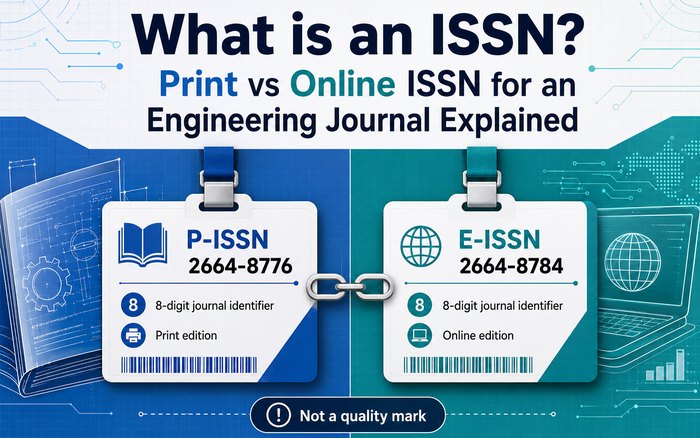
An ISSN is an eight-digit International Standard Serial Number that identifies a journal as a title. A journal published in both print and online form gets two: a P-ISSN for the print edition and an E-ISSN for the online one. This engineering journal carries P-ISSN 2664-8776 and E-ISSN 2664-8784. An ISSN identifies the journal; it says nothing about its quality.
Authors run into engineering journal ISSNs when a submission form asks for one, when a university form demands it, or when they are trying to work out whether a journal that emailed them is real. This guide covers what the number is, how to read it, how to check it, and what it cannot tell you.
Eight digits, printed as two groups of four with a hyphen:
2664-8776
The digits carry no meaning — they are not a year, a country or a subject code. Numbers are simply assigned in sequence, which is why two journals in completely different fields can have adjacent ISSNs.
The eighth character is a check digit, calculated from the first seven. Its whole job is to catch typing errors: change one digit and the check fails. Where the calculation produces the value 10 it is written as the letter X. So an ISSN ending in X is correct, not a mistake — a point that costs authors time when a form rejects it.
| This journal | What it identifies | |
|---|---|---|
| P-ISSN | 2664-8776 | The printed edition |
| E-ISSN | 2664-8784 | The online edition |
| ISSN-L | one of the two | A linking number that groups both records as one title |
Print and online are treated as separate media, so each gets its own number. When a form asks for “the ISSN” without saying which, give the one for the version you actually used — for anything you read or downloaded from the website, that is the E-ISSN.
The ISSN-L exists because databases need a single handle for a title that appears in two forms. Without it, the print and online records of the same journal would look like two different journals.
| Identifier | Identifies | Example | Changes when? |
|---|---|---|---|
| ISSN | A journal, as a title | 2664-8776 | Never, unless the title changes |
| ISBN | One book or one edition | 978-… | New edition, new ISBN |
| DOI | One article or document | 10.33545/… | Never; the link behind it is updated |
The confusion that matters: an ISSN cannot get you to a paper. It identifies the container. To point at one article you need its DOI. A reference list that gives the journal’s ISSN but not the article’s DOI is missing the useful half.
Every ISSN is registered with the ISSN International Centre and the record is public. Open:
portal.issn.org/resource/ISSN/2664-8776
Three things to look at when the record loads:
If a journal’s website shows an ISSN that does not resolve on the portal at all, stop there. That is the single fastest check you can run on an unfamiliar journal, and it costs two minutes.
This is where authors assessing an engineering journal get hurt. An ISSN is an administrative identifier. Obtaining one is a registration step, not an assessment, and a journal with no peer review at all can hold a perfectly valid ISSN.
So “we have an ISSN” in a solicitation email means almost nothing. The things that do mean something are checkable in the same few minutes: is the review process described, are the indexing claims verifiable, does every article get a DOI, and are the charges stated openly before submission.
The number is issued by an ISSN National Centre, which is a body designated in each country, working under the ISSN International Centre in Paris. A publisher applies with the title, the medium, the frequency and a sample issue; the centre checks that the title is distinct and assigns the next number in sequence.
Two consequences follow, and both matter when you are assessing an unfamiliar engineering journal. First, nobody evaluates the content at this stage — the check is on the title and the paperwork. Second, the number is issued once and is not reviewed again, so an ISSN granted in 2019 says nothing about how the journal operates in 2026.
Solicitation emails lean on ISSNs precisely because the number sounds official and is trivial to obtain. “Our journal is ISSN registered” is a sentence that is usually true and never useful.
The reason the number still helps is different from what those emails imply. It helps because the register is public and independent. You can look up the record yourself and compare it against what the website claims. Three mismatches are worth walking away from:
None of these is proof of bad intent on its own. All three are reasons to look harder at the review process, the indexing claims and the charges before you send a manuscript anywhere.
Both numbers are printed in the sidebar of every page of this engineering journal, and they appear in the structured data the site publishes so that databases and search engines can read them without a human transcribing anything:
| Where | What you see |
|---|---|
| Sidebar, every page | P-ISSN: 2664-8776 / E-ISSN: 2664-8784 |
| Printed issues | On the cover and in the masthead |
| Structured data | Both values in the journal record |
If you need to quote the journal in an institutional form and are unsure which number is wanted, give both and label them. No form has ever objected to more precision.
International Standard Serial Number. It is an eight-digit code that identifies a serial publication — a journal, a magazine, a newspaper — as a title, not any individual article within it.
Because the print edition and the online edition are treated as separate media and each gets its own number. This journal carries P-ISSN 2664-8776 for print and E-ISSN 2664-8784 for the online version. Quote whichever medium you actually used.
A linking ISSN. Where a title exists in more than one medium, one of the numbers is designated the ISSN-L so that databases can group the print and online records as a single title.
No, and this is the most damaging misunderstanding. An ISSN is an identifier, not a quality mark. Getting one is an administrative step, not an assessment. Check peer review, indexing and DOIs separately.
On the ISSN Portal at portal.issn.org, which is run by the ISSN International Centre. Put the number after /resource/ISSN/ in the address. If the record does not exist or names a different title, the number on the website is wrong.
A check digit. The eighth character is calculated from the first seven, and where that calculation produces the value 10 it is written as X. So 2664-844X is a valid ISSN, not a typo.
The other identifiers and where they are used:
Created by Brij Mohan Gupta • 24 Jul 2026
P-ISSN: 2664-8776
E-ISSN: 2664-8784

International Journal of Research in Engineering