P-ISSN: 2664-8776
E-ISSN: 2664-8784

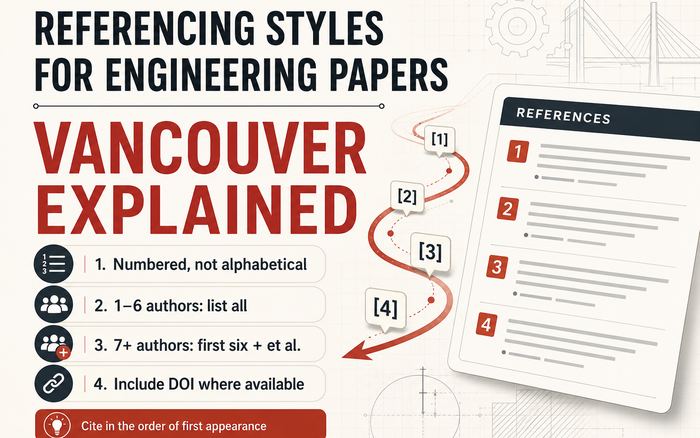
This engineering journal uses Vancouver style: references are numbered in the order they first appear in the text, up to six authors are listed in full, and seven or more become the first six followed by et al. Include the DOI wherever the source has one.
Reference formatting is the part of an engineering journal manuscript most often done at midnight before submission, and it is one of the easiest reasons to be sent back before review. It is also entirely mechanical, which means it can be got right every time.
This is the point that catches authors moving to an engineering journal from another style. In Vancouver, reference 1 is the first source you cite anywhere in the text — not the first alphabetically. Cite it again on page nine and it is still reference 1.
“Fatigue behaviour of welded joints has been studied extensively [1–3], though the effect of post-weld treatment remains disputed [4].”
A reference list sorted alphabetically is the giveaway that the manager was set to the wrong style. It looks tidy and it is wrong, and an editor spots it in two seconds.
| Number of authors | What to list |
|---|---|
| 1 to 6 | All of them |
| 7 or more | The first six, then et al. |
Surname first, then initials without full stops: Kumar A, Sharma RK, Patel M. Not A. Kumar, and not Kumar, A. The difference is small and it is the sort of thing a copy-editor will send back.
Al-Habian A, Harikumar PE, Stocker CJ, Langlands K, Selway JL. Histochemical evaluation of mouse skin histology. J Histotechnol. 2014 Dec;37(4):115-124.
Authors, title in sentence case, abbreviated journal name, year, month where given, volume, issue in brackets, page range.
Aho M, Irshad B, Ackerman SJ, Lewis M, Leddy R, Pope T, et al. Correlation of sonographic features with tumor grade. J Clin Ultrasound. 2013 Jan;41(1):10-7. DOI: 10.1002/jcu.21990
Seven authors, so six then et al., and the DOI at the end. Our guide on what a DOI is explains why that last element outlives every other part of the reference.
Buckingham L. Molecular diagnostics: fundamentals, methods and clinical applications. 2nd ed. Philadelphia: F.A. Davis; c2012.
Altobelli N. Airway management. In: Kacmarek R, Stoller JK, Heuer AJ, editors. Fundamentals of respiratory care. 10th ed. St. Louis: Saunders Mosby; c2013. p. 732-86.
Give the issuing organisation as author, the title, the place and publisher, the year, and the access date with the URL. A standard cited without its designation and year is not citable — ASTM E8 and ASTM E8-22 are not the same document.
The Instructions to Author page gives worked examples for twenty-two source types, including theses, conference posters, streaming video and wiki entries.
Both number in citation order, and both appear in engineering journal instructions, which is why people assume they are interchangeable. They are not:
| Vancouver | IEEE | |
|---|---|---|
| Numbering | Citation order | Citation order |
| Author format | Surname then initials, no full stops | Initials then surname |
| Journal titles | Abbreviated | Abbreviated |
| Element order and punctuation | Differ | Differ |
Mixing them produces a list that is consistently wrong in a way that is obvious to anyone who works with either. Set your manager to one, and check.
It is easy to treat references as an administrative tax. They do three jobs, and knowing which helps you decide what to cite:
That third point leads to a bad habit worth naming: citation padding, where authors add references that are not used to make a list look substantial. Reviewers in a field can tell, because they know which papers actually bear on the problem.
There is no number, and anyone quoting one is guessing. What matters is coverage: every claim attributed to prior work has a source, the recent literature is engaged with rather than merely listed, and nothing is cited that the paper does not use.
“References are outdated” is a common reviewer comment and it rarely means “add newer citations”. It means the paper does not show awareness of what has happened in the field recently. Adding five 2025 references to the introduction without discussing them does not fix it.
| Mistake | Why it matters | Fix |
|---|---|---|
| Alphabetical list | Wrong style entirely | Set the manager to Vancouver |
| Citing a review instead of the source | Credit goes to the wrong place | Cite the original where you rely on it |
| A DOI that does not resolve | The reference cannot be checked | Test every one before submitting |
| Standard cited without year | Different editions say different things | ASTM E8-22, not ASTM E8 |
| Reference in the list but not in the text | An automatic flag in copy-editing | Search the manuscript for each number |
Citing your own earlier work is legitimate and often necessary — you are building on it and the reader needs the foundation. Two limits are worth keeping in mind.
First, in a double-blind engineering journal, “as we showed previously [7]” identifies you immediately. Write “an earlier study [7] showed” instead: same citation, no signature.
Second, if a substantial share of the list is your own group and the papers are not doing real work in the argument, a reviewer will notice. Cite what the paper needs.
Ten minutes, and it removes an entire category of copy-editing correspondence after acceptance.
One habit prevents most of this: build the reference list as you write, not afterwards. A list assembled in one session at the end is where duplicated entries, missing page ranges and mismatched numbering come from.
Vancouver style. References are numbered in the order they first appear in the text, not alphabetically, and the numbers are used in the text in place of author names.
Up to six authors are all listed. With seven or more, list the first six and then et al.
Include it where the source has one. It is the only part of a reference that keeps working after a publisher redesigns their site, and it lets a reader reach the paper in one click.
No, though they look similar. Both number references in citation order, but the punctuation, author formatting and element order differ. Follow whichever the journal specifies, and do not mix them.
Yes, and you should — but set it to a Vancouver output style and then check the result by hand. Reference managers import errors from databases and reproduce them faithfully.
Where the source is used, in square brackets or superscript as the journal specifies, numbered in order of first appearance. A source cited again later keeps its original number.
The other formatting rules that go with referencing:
Created by Thomas Brennan • 08 Aug 2026
P-ISSN: 2664-8776
E-ISSN: 2664-8784

International Journal of Research in Engineering