P-ISSN: 2664-8776
E-ISSN: 2664-8784

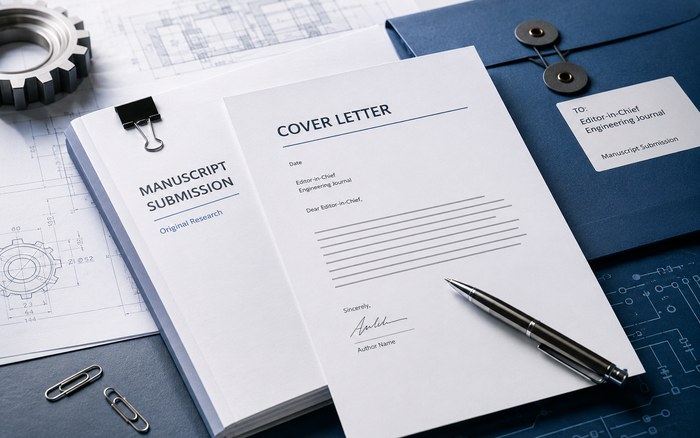
A cover letter for an engineering journal must state that the work is original, has not been published before, and is not under consideration elsewhere. Keep it to one page, say what the paper contributes and why it fits this journal, and send it in MS Word with the manuscript and the signed authorship responsibility form.
The cover letter is the one engineering journal document authors write last and think about least, and it is the first thing the editor reads. It will not rescue a bad paper, but a vague one can slow down a good paper.
The engineering journal editor is answering one question when they open it: should this go to reviewers? Your letter should make that easy by covering three things:
That is the whole job. Everything else is optional and most of it is padding.
[Date]
The Editor
International Journal of Research in Engineering
Dear Editor,
I am submitting our manuscript, “[Full title]”, for consideration as a [research article / review article / case report / short communication] in the International Journal of Research in Engineering.
[One or two sentences: what problem the paper addresses, what you did, and what the main finding is. Plain sentences, no abbreviations.]
[One sentence: why this work fits the scope of this journal.]
I confirm on behalf of all authors that this work is original, has not been published previously, and is not under consideration for publication elsewhere. All authors have read and approved the manuscript and agree to its submission.
[Optional: We suggest the following reviewers, who have no conflict of interest with this work: Name, affiliation, e-mail; Name, affiliation, e-mail.]
Thank you for considering our submission.
Yours sincerely,
[Corresponding author name]
[Affiliation]
[E-mail, phone]
The second paragraph is the only part that varies meaningfully between letters, and it is where most are weak. Compare:
“This paper presents an experimental investigation into composite materials. The results are discussed and conclusions are drawn.”
“This paper reports the effect of fibre loading on the tensile behaviour of jute-epoxy composites, tested at four loadings with five specimens each. Strength peaked at 15 wt% and fell thereafter, which has not previously been reported for hand lay-up laminates of this type.”
The second tells the editor what the paper is, what was done, what was found and why it is new — in two sentences. The first could describe several thousand papers.
You may name two potential engineering journal reviewers, with affiliations and contact details. It is optional, and the editor decides whether to use them. Suggestions are useful when your work sits in a narrow area where finding qualified reviewers is genuinely hard.
People who should not be on the list: your supervisor, your co-authors, anyone at your institution, and anyone you have published with recently. A reviewer who cannot be objective is not a reviewer, and naming one tells the editor something about your judgement rather than about your paper.
| Article type | What to change in paragraph 1 | What to emphasise in paragraph 2 |
|---|---|---|
| Research article | “as a research article” | What was measured, and the main number |
| Review article | “as a review article” | The scope covered and why a review is needed now |
| Case report | “as a case report” | What makes this case instructive |
| Short communication | “as a short communication” | Why the finding is worth reporting early |
| Letter to the Editor | Name the article you are responding to | The specific point you are making |
Naming the type in the first line matters more than it looks. Each category has its own length limit and expected structure, and an editor who has to work out which one you meant is starting on the wrong foot.
“Please find attached our manuscript for your consideration.” It omits the required declarations, so the editor has to ask for them, and a round of email is added before anything begins.
A full summary of the study, a literature review and a paragraph about the research group. The editor is reading dozens of these; length does not signal seriousness, it delays the decision.
“This groundbreaking study represents a paradigm shift.” Reviewers will compare that claim against your results, and a gap between the two costs more credibility than a modest description ever would.
Item 1 is worth checking twice. Editors see it regularly, and it tells them the paper was rejected elsewhere and sent on without being reread — which is a poor start for an otherwise good manuscript.
The cover letter is one of three documents that must arrive together: the letter in MS Word, the signed authorship responsibility form, and the complete manuscript with all figures and tables carrying headings. Sample files for all three are on the Instructions to Author page.
Send them together. A manuscript arriving on its own does not start a review, and nobody chases you for the missing files — our pre-submission checklist covers the rest.
A cover letter cannot make a weak paper publishable, and nobody should pretend otherwise. What it can do is remove friction: the editor gets the declarations they are required to have, understands in twenty seconds what the paper claims, and can see that it belongs in this journal.
That is the difference between a manuscript that moves to review on the day it arrives and one that generates two emails first. Over the life of a paper it is not a large saving, but it is entirely free — and it is the last impression you make before somebody decides whether to send your work to reviewers.
That the work is original, has not been published before, and is not under consideration elsewhere. Send it in MS Word alongside the manuscript and the signed authorship responsibility form.
One page. An editor reads it in under a minute to decide whether the paper goes forward, so length works against you.
You may name two potential reviewers with their affiliations and contact details. It is optional and the editor is not obliged to use them. Suggesting your supervisor or a co-author wastes the opportunity.
Yes. This journal requires it as one of three documents, and a submission missing any one of them cannot start.
No. The editor has the abstract. Use the letter to say what the paper contributes and why it fits this journal — which the abstract does not do.
The corresponding author, on behalf of all co-authors.
What the cover letter accompanies:
Created by Laila Farouk • 09 Aug 2026
P-ISSN: 2664-8776
E-ISSN: 2664-8784

International Journal of Research in Engineering