P-ISSN: 2664-8776
E-ISSN: 2664-8784
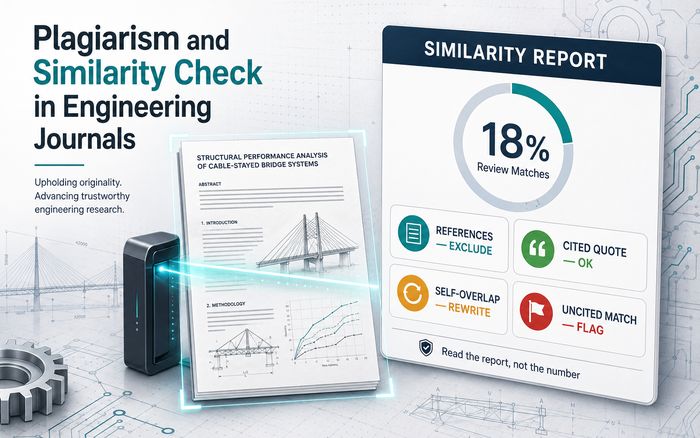
Every paper submitted to this engineering journal is screened through Similarity Check, the Crossref service that compares your manuscript against published literature. Authors found guilty of plagiarism are debarred from publishing here for six months, and a paper found to be plagiarised after publication is retracted under COPE guidelines with the authors blacklisted.
Almost nobody submitting to an engineering journal sets out to plagiarise. Most similarity flags come from habits that feel harmless while you are writing, and they are all avoidable if you know what the check actually looks for.
Similarity Check compares your text against a large body of published work and returns a report showing matching passages and where each match came from. It is a text-matching tool, not a judgement: it can tell you that thirty words appear elsewhere, and it cannot tell whether that is a properly quoted definition or a lifted paragraph.
That distinction is the whole of it. An editor reads the report, not the percentage.
| Score | Made up of | Verdict |
|---|---|---|
| 25% | Standard method phrases, an attributed quotation, the reference list | Usually fine |
| 12% | One uncited paragraph from another paper | Serious |
| 8% | Your own earlier methods section, verbatim, uncited | Needs fixing before submission |
| 30% | A standard test procedure quoted from ASTM, cited | Depends on how much is quoted |
A journal that publishes a fixed acceptable percentage is describing a rule of thumb, not the actual assessment. Where the overlap sits matters more than how much of it there is.
You wrote the methods paragraph two years ago for another engineering journal for a related paper. The equipment has not changed, so you paste it in. It matches, and the system does not care that you wrote it.
The fix is straightforward: describe the method briefly in your own new words and cite the earlier paper for the detail. You keep the citation and lose the flag.
In engineering journal papers, standard descriptions of well-known techniques get worded almost identically by everyone. “Tensile tests were conducted using a universal testing machine in accordance with ASTM D3039 at a crosshead speed of 2 mm/min” appears in hundreds of papers because there are only so many ways to say it.
Cite the standard and write the sentence in your own construction. It will still match a little; that is expected and not a problem.
A definition dropped into the text without quotation marks or a citation, usually because it was pasted into notes months earlier and its origin was forgotten. Keep sources attached to text from the moment you paste it.
Changing three words in a sentence and rearranging the clauses is not paraphrasing, and text-matching tools are built to catch exactly that. Real paraphrasing means understanding the point and writing it in your own structure — and citing the source anyway.
The report is a list of matched passages with a source for each. Work through it in this order rather than looking at the headline number:
Fifteen minutes with the report before submission is worth more than any amount of worrying about the percentage afterwards.
Three different problems get grouped together, and only the first is plagiarism:
| Problem | What it is | Why it matters |
|---|---|---|
| Plagiarism | Using someone else’s words or ideas without attribution | Misrepresents whose work it is |
| Duplicate publication | Publishing the same work in two venues | The record counts one study twice |
| Salami slicing | Splitting one study into several thin papers | Inflates output, fragments the finding |
Duplicate publication is why your cover letter must state that the work is not under consideration elsewhere, and why simultaneous submission to two engineering journals is prohibited. Salami slicing is harder to define — the honest test is whether each paper stands as a complete piece of work, or whether a reader would need the others to make sense of it.
Text produced by a language model may not match anything in a similarity database, because it was generated rather than copied. That does not make it safe to submit as your own writing.
Two practical points. Journals increasingly ask authors to declare any use of such tools, so check the policy before you rely on one. And a model will produce confident, fluent sentences about your experiment that are not supported by your data — which is a far more serious problem for an engineering paper than a similarity score, and one that reviewers catch by comparing claims against results.
If you use a tool to improve the English of text you wrote, that is editing. If it wrote the substance, that is authorship, and it is not yours to claim.
| When | Consequence |
|---|---|
| Before publication | Guilty authors are debarred from publishing for six months |
| After publication | The paper is retracted under COPE guidelines and the authors are blacklisted |
A retraction is permanent and public. The article stays online, marked as retracted, and that marking is what appears in databases and search results afterwards. It is the outcome worth the most effort to avoid.
The journal follows COPE guidelines for retraction, and the full policy is on the publication ethics page.
One last habit that prevents nearly all of this: keep a single notes file per project where every pasted line carries its source on the same line. It costs seconds while you read and it removes the situation that causes most accidental plagiarism — finding a good sentence in your own notes months later and no longer knowing whether you wrote it.
Nothing about this process is designed to catch you out. The screening exists so that the work published under your name is demonstrably yours, which is the same reason you would want it.
Every submitted paper is screened through Similarity Check, the Crossref service that compares your manuscript against published literature. It runs on submissions before they reach reviewers.
Authors found guilty are debarred from publishing in the journal for six months. A paper found to be plagiarised after publication is retracted, following COPE guidelines, and the authors are blacklisted.
No single number decides it, and any journal quoting one is oversimplifying. A 25% score made up of standard method phrases and correctly cited quotations is different from a 12% score concentrated in one uncited paragraph. What matters is where the overlap is and whether it is attributed.
Yes. Self-plagiarism registers exactly the same as any other overlap. Reusing your own methods paragraph verbatim is the commonest way honest authors trigger a similarity flag — cite the earlier paper instead of repeating it.
The reference list will match other papers by definition, and most reports can exclude it. What matters is overlap in the body of the paper.
Yes, and you should. Run it through a similarity tool while you can still fix what it finds, rather than discovering it after submission.
What happens when originality is questioned:
Created by Marcus Lindqvist • 08 Aug 2026
P-ISSN: 2664-8776
E-ISSN: 2664-8784

International Journal of Research in Engineering