P-ISSN: 2664-8776
E-ISSN: 2664-8784

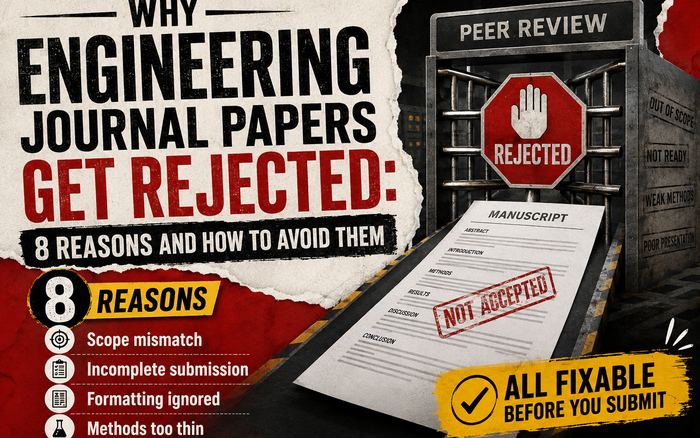
Most engineering journal papers are rejected for reasons that have nothing to do with the quality of the science. Scope mismatches, incomplete submissions, formatting that ignores the specification, and methods described too thinly to evaluate account for a large share of rejections — and every one of them is fixable before you submit, at no cost.
Rejection from an engineering journal feels like a judgement on the work. Usually it is a judgement on the reporting, and the two are much easier to separate once you know which gate stopped you.
| Desk rejection | Post-review rejection | |
|---|---|---|
| Who decides | The editor, alone | Subject Editor, on two reviewers’ reports |
| When | Before review | After double-blind review |
| Typical cause | Scope, completeness, format, similarity | Methods, analysis, over-claimed conclusions |
| Cost to fix | Hours — often minutes | Weeks, sometimes more data |
| What you receive | A short editorial note | Reviewer reports |
The first thing to do with any rejection is work out which one you got. A one-line note means the science was never read; reports mean it was. They call for completely different responses.
The editor’s first job is to check the manuscript against editorial policy. A paper on a subject the journal does not cover is returned without review, however good it is. This costs the author months and the editor five minutes.
Fifteen minutes prevents it: read the aim and scope, then the titles in the two most recent issues. Our guide on choosing an engineering journal covers the full check.
Three documents go together here — a cover letter, a signed authorship responsibility form, and the complete manuscript with all figures and tables carrying headings. A submission missing any one cannot start. The file simply sits, and the author assumes it is under review.
Format is not taste. Every item below is checkable in under a minute:
| Requirement | Specification |
|---|---|
| File | MS Word (.doc / .docx) |
| Length | Not more than 15 pages |
| Abstract | Not more than 300 words |
| Keywords | 3 to 6 |
| References | Vancouver style, numbered in citation order |
| Figures | 75 mm or 155 mm wide, 300 dpi |
Failing several of these signals that the author instructions were not read, and an editor reasonably wonders what else was skipped.
Every submission is screened for similarity. The consequences here are stated plainly: plagiarism found before or after publication leads to retraction and the authors being blacklisted.
Two forms surprise honest authors. Self-plagiarism — reusing your own methods paragraph verbatim from an earlier paper — registers exactly the same; cite the earlier paper instead. And boilerplate, the standard description of a well-known test that everyone words identically. Rewrite it and cite the standard.
This is the commonest reason an engineering journal paper fails after review. A reviewer cannot recommend acceptance for a study they are unable to judge. In engineering that usually means one of these is missing:
None of these require more experiments. They require writing down what you already did.
Reviewers compare your conclusion against your data, sentence by sentence. Papers are rejected when the gap is too wide — a single specimen batch at one temperature concluding that a material is “suitable for structural applications”.
The same study framed as a first result that warrants wider testing is publishable. The data did not change; the claim did.
Papers are rarely rejected for grammar alone, but they are rejected when a reviewer cannot reliably tell what was done. If two readings of a methods sentence give two different experiments, the reviewer has to guess, and guessing resolves against the author.
Before submitting, have a colleague who did not do the work read your Materials and Methods and describe the experiment back to you. Every point where their description differs is a sentence to rewrite.
The revised manuscript is expected back within one week. A revision that silently ignores half the comments is a common way to turn a “major revision” into a rejection.
Answer every point, in order, including the ones you disagree with — a reasoned disagreement is respected, silence is not. Our guide on responding to reviewer comments shows the format.
Authors often ask what proportion of papers a journal rejects. This engineering journal does not publish that figure, and we are not going to invent one — a number quoted without a source is worth nothing to you.
It is also a less useful number than it looks. A high rejection rate can mean a selective journal or a journal receiving a lot of out-of-scope submissions. A low one can mean a well-matched readership or no filtering at all. The figure tells you nothing on its own, which is why the checks that matter are the ones you can run yourself: is the review process described, does it happen, and what are the charges.
| Reason | Where it stops you | Time to fix |
|---|---|---|
| Scope mismatch | Desk | 15 minutes of reading, before you submit |
| Missing cover letter or authorship form | Desk | 10 minutes |
| Abstract over 300 words | Desk | 20 minutes |
| References in the wrong style | Desk | An hour with a reference manager |
| Figures below 300 dpi | Desk or production | Re-export from the original files |
| Replication count not stated | After review | One sentence |
| No significance level given | After review | One sentence per result |
| Conditions not stated | After review | Two sentences |
Every row in that table is reporting, not research. Together they account for a large share of what actually stops papers at an engineering journal, and none of them needs a single extra experiment.
A rejection contains information you paid months for. Three questions get it out:
Before review: scope mismatch, or an incomplete or wrongly formatted submission. After review: methods described too thinly for a reviewer to evaluate — missing replication, design, controls or statistics.
A rejection made by the editor before the paper reaches reviewers. Here every submission is read once against editorial policy and a minimum quality level; only papers that pass go to two reviewers.
If the rejection was for scope or formatting, fixing it and resubmitting is reasonable. If it was rejected after peer review on scientific grounds, address the substantive objections first — an unchanged manuscript reaches the same conclusion.
Not necessarily. A large share of rejections are for scope, completeness, formatting or reporting, none of which say anything about the underlying work. Those are also the cheapest to fix.
One week at this journal. Read the comments the day they arrive even if you start work later.
Only if you can point to a factual error in the report — a reviewer misreading a number, or asking for something the paper already contains. Appealing because you disagree with the judgement rarely works and costs weeks.
How to remove the avoidable rejections before you submit:
Created by Priya Nair • 08 Aug 2026
P-ISSN: 2664-8776
E-ISSN: 2664-8784

International Journal of Research in Engineering